![AERO 40 Ⅱ ディスクブレーキホイール[リム内幅23mm] - ICANホイールジャパン](http://icanjp.com/cdn/shop/files/1_d90bc651-48bd-4f22-9e13-6d963c283ba6_1370x.jpg?v=1753869976)
![AERO 40 Ⅱ ディスクブレーキホイール[リム内幅23mm] - ICANホイールジャパン](http://icanjp.com/cdn/shop/files/2_37e9600e-9785-4d45-abe1-df49da71e7ee_1370x.jpg?v=1753869976)
![AERO 50 Ⅱ ディスクブレーキホイール[リム内幅23mm] - ICANホイールジャパン](http://icanjp.com/cdn/shop/files/ICANAERO50IIDiscWheels_1_1370x.jpg?v=1758088613)
![AERO 50 Ⅱ ディスクブレーキホイール[リム内幅23mm] - ICANホイールジャパン](http://icanjp.com/cdn/shop/files/ICAN_AERO_50_II_Disc_Wheels_2_1370x.jpg?v=1758088881)


![FL40Ⅱ ワイドリムロードカーボンホイール 軽量「内幅23mm] - ICANホイールジャパン](http://icanjp.com/cdn/shop/files/1_771b4686-2e73-4d35-b47c-b123b298f7f7_1370x.jpg?v=1755486826)
![FL40Ⅱ ワイドリムロードカーボンホイール 軽量「内幅23mm] - ICANホイールジャパン](http://icanjp.com/cdn/shop/files/2_76389d17-9f29-42af-aa59-a695414fcaf7_1370x.jpg?v=1755486826)
Talking about road bike spokes and hubs
Spokes and hubs are components we don't usually pay much attention to, nor can we choose them ourselves.
However, the topic of these parts is quite interesting.
So, let's talk about spokes and hubs, another important component of wheels.
Spoke Air Resistance is More Important Than Rim
Currently, spokes come in various shapes.
In addition to the conventional round cross-sections, aero-shaped spokes are becoming more common.
This indicates how much spokes affect aerodynamics.
Imagine a wheel rotating.
The lower half of the wheel, below the central hub, rotates in the same direction as the bike is moving.
Therefore, not much air resistance is generated in this section.
What about the upper half of the wheel? It rotates in the opposite direction to the bike's movement! This generates significant air resistance.
Therefore, shaping the spokes to align with this direction and reducing resistance as much as possible is an effective measure for aerodynamics.
Furthermore, multiple spokes intersecting can easily create turbulent airflow. While a disc-shaped wheel, covered with plates on the sides, can offer aerodynamic benefits, it becomes heavily affected by crosswinds.
Road Bike Spoke Patterns
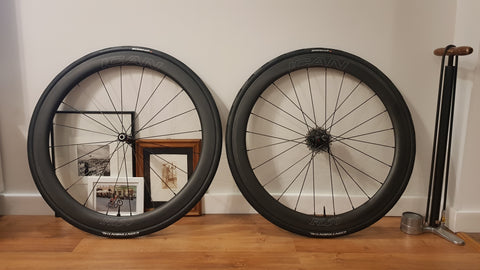
In addition, batten wheels have been considered as a measure to reduce air resistance, but there is currently no definitive solution for road bikes.
Therefore, considering spoke patterns becomes one of the practical aerodynamic measures.
Here, I'd like to consider the forces that spokes bear.
Spokes can be described as wire rods. Wire rods are weak when pushed but strong when pulled. Therefore, wheels also utilize the pulling force of spokes.
A stationary wheel is supported by spokes suspending the central hub from above. Surprisingly, at this time, the other spokes are effectively not subjected to any stress.
When you turn the cranks, another force is applied to the spokes. This is where the spokes that lean backward relative to the direction of travel come into play. However, this only applies to the rear wheel. The front wheel, which doesn't contribute to propulsion, doesn't experience stress, allowing for a simpler spoke lacing pattern.
What about when you stop? With disc brakes, it's a bit more complex. During braking, spokes in the opposite direction receive force from the hub.
Therefore, disc brake wheels require more spokes. This is why disc wheels use a tangential lacing pattern and not a radial lacing pattern.
In reality, wheel manufacturers test every possibility, settling on the patterns we see today.
From sprint wheels with the absolute minimum number of spokes to robustly built wheels prioritizing durability, there are options that can serve as a guide when choosing.
[Reference Article] A Thorough Explanation of Bicycle Spoke Lacing
About Spoke Tension

Wheels that have covered a lot of distance will naturally show some wear, but a drop in spoke tension due to stretching often goes unnoticed. In some cases, there might be differences in tension between individual spokes, leading to an imbalance.
For well-ridden wheels, having a professional shop adjust the spoke tension once might have an unexpectedly refreshing effect.
Know the Hub Structure Too
There are broadly two types of hub bearing structures.
① Cup & Cone Type
This has been used for a long time and consists of separate cup and ball components, requiring maintenance. However, by regularly replacing grease and adjusting clearance, it's possible to maintain optimal condition, and some models from Shimano and Campagnolo still use this system.
② Sealed Bearing Type (Cartridge Bearing)
This type has the entire internal structure covered by seals, achieving maintenance-free operation. It is adopted by the majority of current models. No adjustment is needed; if play develops, the entire bearing unit is replaced.
There is no performance difference between cup & cone and sealed bearings. However, there is a clear difference in grade due to bearing precision.
In fact, Japanese bearings hold a high market share and are considered to be outstanding in precision.
Difference Between Quick Release and Thru-Axle
Quick-release levers have traditionally been used for attaching and detaching road bike wheels. However, with the adoption of disc brakes, the thru-axle system has become common due to its enhanced rigidity, as you know.
Whereas quick releases use a thin skewer to clamp the fork ends from both sides, thru-axles use a thick skewer that passes through the fork. While this makes removal and attachment slightly more cumbersome in a hurry, it is an effective method for increasing rigidity and reducing rotational resistance.
ICAN AERO40 DT240s/350s Disc Wheelset

Introducing the 40mm deep ICAN carbon wheelset for disc brakes.
The price for the front and rear set is 105,570 JPY (tax included).
This is a reliable model with UCI certification and a 2-year warranty.
The spokes are Sapim CX-Ray, a well-regarded aero spoke product.
The hubs used are DT Swiss DT240S/350S.
Both are globally recognized parts, further enhancing the reliability of ICAN wheels.
Summary
How was it?
I hope this information helps you make a better choice when selecting wheels.
ICAN wheels are manufactured with meticulous attention to even the smallest parts.
We would be delighted if you consider them as an option.
[Reference Articles]
・What are the Pros and Cons of Carbon Spokes?
・Talking about Road Bike Spokes
・Talking about Road Bike Spokes