![AERO 40 Ⅱ ディスクブレーキホイール[リム内幅23mm] - ICANホイールジャパン](http://icanjp.com/cdn/shop/files/1_d90bc651-48bd-4f22-9e13-6d963c283ba6_1370x.jpg?v=1753869976)
![AERO 40 Ⅱ ディスクブレーキホイール[リム内幅23mm] - ICANホイールジャパン](http://icanjp.com/cdn/shop/files/2_37e9600e-9785-4d45-abe1-df49da71e7ee_1370x.jpg?v=1753869976)
![AERO 50 Ⅱ ディスクブレーキホイール[リム内幅23mm] - ICANホイールジャパン](http://icanjp.com/cdn/shop/files/ICANAERO50IIDiscWheels_1_1370x.jpg?v=1758088613)
![AERO 50 Ⅱ ディスクブレーキホイール[リム内幅23mm] - ICANホイールジャパン](http://icanjp.com/cdn/shop/files/ICAN_AERO_50_II_Disc_Wheels_2_1370x.jpg?v=1758088881)


![FL40Ⅱ ワイドリムロードカーボンホイール 軽量「内幅23mm] - ICANホイールジャパン](http://icanjp.com/cdn/shop/files/1_771b4686-2e73-4d35-b47c-b123b298f7f7_1370x.jpg?v=1755486826)
![FL40Ⅱ ワイドリムロードカーボンホイール 軽量「内幅23mm] - ICANホイールジャパン](http://icanjp.com/cdn/shop/files/2_76389d17-9f29-42af-aa59-a695414fcaf7_1370x.jpg?v=1755486826)
[Amazing] Explaining the Effects and Benefits of Hill Climb Wheels
12 Aug 2020
0 Comments
Hello, this is ICAN. "Is there a road bike wheel or hybrid bike wheel with the best cost-performance ratio?" "I'm looking for an ultra-lightweight wheel for cycling and racing." Today, I'll be answering these questions. Hill climbs involve cycling uphill, so to unleash your maximum power, your wheels must be light. A heavier bike makes climbing hills much harder. So, in this article, we'll delve into the "effects and benefits of using hill climb wheels" and "whether making your bike lighter actually makes you faster." This article is written for people who do hill climbs, but the same principles apply to anyone who cycles, regardless of the type of bike they ride, so please read until the end!


What is a hill climb? It means cycling uphill.
A hill climb is a race where you cycle uphill. It's about competing for the best time on steep inclines, while also enjoying the scenery. That said, climbing with friends or even alone can be considered a hill climb, so it might be interesting to give it a try. The sense of accomplishment after reaching the top, and the delicious food at establishments along the way, are truly delightful. By the way, there's a cycling app called "Strava." It records the distance and time you've ridden, your speed, and even course records set by others, so you can race using the app. It's compatible with both iPhone and Android, making it a must-have for riders.[Hill Climb] You can experience amazing effects just by changing your road bike wheels.
You can experience astonishing lightness just by replacing your current wheels with hill climb wheels. Most wheels designed for hill climbs are lightweight and built to be strong against climbs and crosswinds.
Reasons why changing wheels alone can bring a noticeable effect in weight reduction
So, why can you feel the effect just by switching to hill climb wheels? It's because the wheels are the part that directly touches the ground. In short, the power generated by pedaling is directly transmitted to the ground, and the weight and performance of the wheels significantly affect the rider. Additionally, a lighter wheel makes it easier to ride. Therefore, lightweight wheels are generally recommended. Using lightweight wheels for hill climbs will increase your propulsion on slopes.[Hill Climb] Which part of the wheel is most cost-effective to lighten?
It's not as simple as just making the wheels lighter. There are certain parts that should be prioritized for weight reduction, and I'll explain them.
Hill Climb Wheel Weight Reduction 1: Lighter Rims
If your current wheels and the wheels you're planning to buy or replace are the same weight, it's best to choose "lighter rims" (wide rims or narrow rims). Lighter rims improve acceleration, which is quite advantageous in Japan with its many traffic lights. Conversely, deep rims can make the bike heavier and have significant disadvantages for those not used to them, so they are not highly recommended. However, heavy rims don't only have disadvantages; some can help maintain speed once you get going. Incidentally, I felt a difference in propulsion just by lightening the rims.Hill Climb Wheel Weight Reduction 2: Smooth-spinning Hubs
The hub is located at the center of the wheel and is a crucial component responsible for the wheel's rotational performance. High-end hubs are made of carbon, making them an indispensable part for those who prioritize weight. Additionally, high-performance hubs can reduce rotational resistance, allowing you to fully exert your pedaling power. The clicking sound (ratchet sound) you hear when you stop pedaling comes from the hub. It's also recommended to look for a hub that makes a sound you like.Hill Climb Wheel Weight Reduction 3: Pay attention to the number and shape of spokes
Spokes are the long rods that support the wheel. The length, thickness, design, and weight of spokes vary greatly depending on the wheel, so if you're getting new wheels, it's worth paying attention to them. A higher number of spokes disperses the force received from the ground and absorbs impacts from bumps, making them an essential part for riders. Additionally, spokes come in two material types: "steel" and "aluminum." If you prioritize durability for acceleration on slopes and preventing falls on slopes, aluminum spokes are good. If you want to make them as light as possible, steel spokes are recommended. For more information on the effects and benefits of spoke count, please refer to "A thorough explanation of bicycle spoke lacing methods [for beginners]."Supplement: What about losing your own weight for hill climbs?
If you want to reduce the weight of your bike, you have to buy expensive parts. So, people on a budget inevitably end up with heavier bikes, and sometimes they just can't compete with wealthier riders. In such cases, the suggestion is to lose your own weight. It's easier to lose weight from your body than to change parts, and therefore, the effect on reducing your time is greater. However, if you lose too much weight, muscle mass reduction can lead to decreased power and stamina, which can actually slow you down. You should avoid significantly reducing your body weight. Also, if you're wondering whether to go for carbon wheels or aluminum wheels, please refer to "What are the benefits of using carbon wheels?"[Hill Climb] How to "speed up" your bicycle
Here, we will look at ways to speed up your bicycle, which will be very useful for hill climbs. Rims are divided into three types: "deep rim," "wide rim," and "narrow rim," and knowledge of these is essential for cycling on hills.Pros and Cons of Deep Rims
Deep rims are wheels with a rim height of 50mm or more, offering a good balance of convenience and riding stability. The main advantage is reduced air resistance at high speeds. For hill climbs, where you might exceed 40 km/h, you'll feel the benefits of deep rims. The disadvantages include increased rim weight and poorer acceleration compared to wheels with lower rim heights, making them unsuitable for roads with frequent stops. Furthermore, there's a risk of losing balance due to wind force when overtaken by trucks or buses, or when riding along the coast, so it's best to avoid deep rims for hill climbs.Pros and Cons of Wide Rims
"Wide" means wide, so it refers to wheels with a wide rim width (rim widths range from 15mm to less than 50mm). When the rim is larger, the amount of air in the tire increases, which is expected to improve the comfort of the ride due to the weight of the air, and enhance grip performance (straight-line stability and cornering performance). However, as the name suggests, wide rims tend to be heavier due to the increased material. Therefore, narrow rims are recommended for people who do hill climbs.Pros and Cons of Narrow Rims
"Narrow" refers to a rim width of up to 15mm (the width varies by manufacturer). Simply put, it means slightly narrower than a wide rim, and from a weight perspective, this is recommended. You can also expect good grip performance and comfort. If you do hill climbs, definitely consider it.[Hill Climb] About the effects of weight reduction
Earlier, I explained that when it comes to making your bike faster for hill climbs, you should reduce the weight of wheel parts for safety reasons rather than reducing your own body weight. This is because significantly reducing your own weight can lead to a condition called bulimia (symptoms include vomiting or diarrhea after eating a large amount of food), so you should avoid drastic weight loss. For example, if you diet before a race or a long-distance cycling trip and then eat a lot afterward, this could happen. In other words, while the effects of weight loss are significant, the risks are also substantial.Beware of disadvantages that arise from lightening parts
However, lightening parts also comes with disadvantages. For high-speed riding on flat terrain, deep rims are more advantageous, despite being heavier than lightweight wheels with low rims. Even when pursuing speed in hill climbs, some riders might find they can ride faster with wheels that offer higher maneuverability, rather than focusing solely on wheel weight. Therefore, whether you should lighten your bike or prioritize maneuverability depends on your intended use and purpose for riding.[Conclusion] Heavier wheels are actually better for hill climbs.
In hill climbs, heavier wheels are actually more effective. This is due to the theory that underpins bicycles, the gyroscopic effect (which stabilizes the bicycle's balance). When you apply force to the pedals, your body and the bicycle lean forward, but this can cause you to lose balance. Therefore, we naturally adjust the bicycle's balance by counteracting the "gyroscopic restoring force of the wheels" with "shifts in body weight," "handlebars," and "saddle." If the gyroscopic restoring force of the wheels is high, less input is needed from the handlebars, saddle, and shifts in body weight. However, on steep hill climbs, speed inevitably decreases, so the gyroscopic restoring force becomes considerably smaller than it is on flat terrain. Therefore, it is necessary to make the wheels and tires heavier to increase the gyroscopic restoring force. This, in turn, reduces the strain on the handlebars, saddle, and leg muscles.Recommended Popular Wheels
Finally, I'll introduce the wheels we sell. I'll introduce two wheels that will be very active during hill climbs.[Ultra-lightweight] Carbon Wheel "AERO 40" 76,670 yen
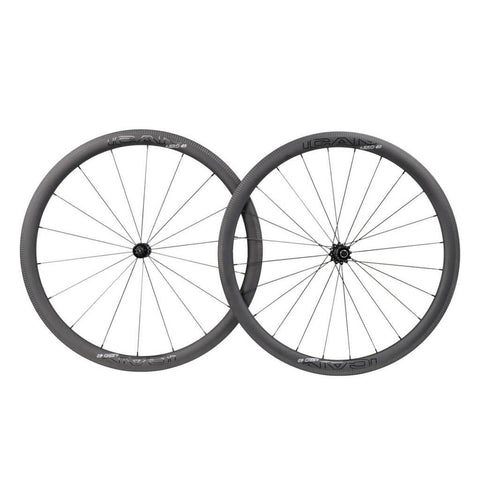
ICAN Hill Climb Wheel AERO 40 Carbon Wheel
If you're looking for ultra-lightweight wheels, "AERO 40" is recommended. The total weight is 286g, an unbelievable lightness for this price range. The Aero series uses a combination of T700 and T800 carbon materials, making them carbon wheels. They use CX-Ray series spokes, which have achieved the best results in spoke fatigue tests. They are lightweight and incredibly strong. So, you can even compete in road races with these wheels. These wheels are used by top-class cyclists and triathletes around the world.
[Suitable for both hill climbs and cycling] Carbon Wheel "AERO 35" 75,670 yen
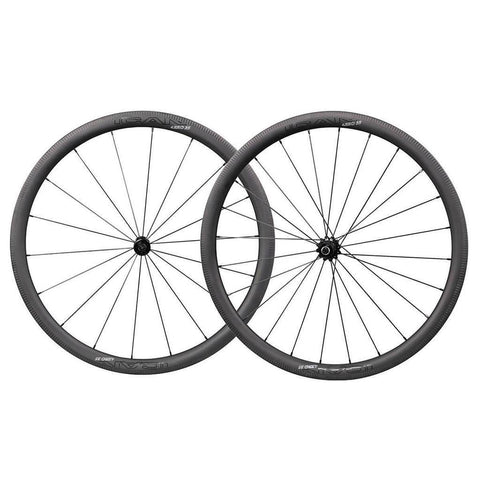
ICAN Hill Climb Wheel AERO35 Carbon Wheel
The "AERO 35" carbon wheel has a rim width of 35mm, meaning it's a wide rim. It's designed to handle any course. While wide rims are a bit heavier than narrow rims due to their greater width, they are expected to improve riding comfort due to the increased air volume and enhance grip performance. Therefore, whether you want to do hill climbs as a hobby, go cycling, or even ride on gravel roads, this wheel alone can take you to many different places.
Don't over-lighten everything: Summary
It's not always about making everything lighter to ride a bicycle faster. Reducing your own weight can lead to bulimia, and reducing the weight of parts can actually put a greater strain on your leg muscles. Therefore, you should choose whether or not to lighten your bike based on its intended use and purpose for riding.
Tags: