

![AERO 40 Ⅱ ディスクブレーキホイール[リム内幅23mm] - ICANホイールジャパン](http://icanjp.com/cdn/shop/files/1_d90bc651-48bd-4f22-9e13-6d963c283ba6_1370x.jpg?v=1753869976)
![AERO 40 Ⅱ ディスクブレーキホイール[リム内幅23mm] - ICANホイールジャパン](http://icanjp.com/cdn/shop/files/2_37e9600e-9785-4d45-abe1-df49da71e7ee_1370x.jpg?v=1753869976)
![AERO 50 Ⅱ ディスクブレーキホイール[リム内幅23mm] - ICANホイールジャパン](http://icanjp.com/cdn/shop/files/ICANAERO50IIDiscWheels_1_1370x.jpg?v=1758088613)
![AERO 50 Ⅱ ディスクブレーキホイール[リム内幅23mm] - ICANホイールジャパン](http://icanjp.com/cdn/shop/files/ICAN_AERO_50_II_Disc_Wheels_2_1370x.jpg?v=1758088881)


![FL40Ⅱ ワイドリムロードカーボンホイール 軽量「内幅23mm] - ICANホイールジャパン](http://icanjp.com/cdn/shop/files/1_771b4686-2e73-4d35-b47c-b123b298f7f7_1370x.jpg?v=1755486826)
![FL40Ⅱ ワイドリムロードカーボンホイール 軽量「内幅23mm] - ICANホイールジャパン](http://icanjp.com/cdn/shop/files/2_76389d17-9f29-42af-aa59-a695414fcaf7_1370x.jpg?v=1755486826)
Key points to consider when choosing bicycle tires
When riding a bicycle, the tires gradually deteriorate.
Replacing them would solve the problem, but leaving it entirely to a bike shop feels a bit disappointing.
You could either let the bike shop handle the replacement work and just choose the tires yourself, or you could go all out and do everything from tire selection to replacement yourself. Here, I'll explain "how to choose tires" and "points to note when choosing tires."
Road bikes, MTBs, and city bikes (mamachari) all use different types of tires.
First, let's start with the basic knowledge needed for choosing tires.
Types of Tires
There are roughly four types of tires:
"Clincher"
"Tubular"
"Tubeless"
"Puncture-proof"
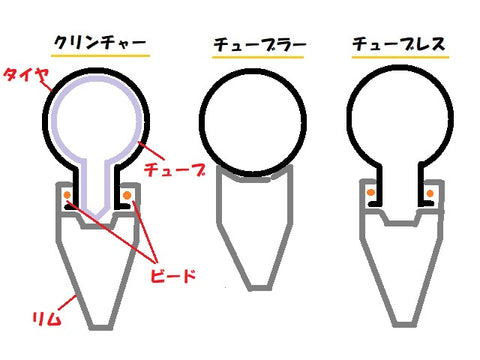
The most common type is the "clincher."
This structure has a separate tube and tire.
The tire's bead is hooked onto the rim of the wheel.
A tube is placed inside the space created.
When air is pumped into the tube, the relationship between the tire, tube, and rim is secured.
This type is good for touring, and recently, it's also being used in races.
Puncture repairs are easy.
"Tubular" tires have the tube built into the inside of the tire.
The tire is attached to the rim with adhesive.
The tire's cross-section is perfectly round, and its shape is stable.
Therefore, the grip remains consistent even when cornering.
While suitable for races, if used for touring, repairing a puncture can be very difficult.
"Tubeless" tires are similar to car tires.
There is no inner tube; air is pumped directly into the tire.
They offer excellent riding performance, high grip, and are less prone to rapid air loss during punctures, so there are many advantages. However, they require special wheels and special tires.
"Puncture-proof" is a relatively new type.
It resembles both clincher and tubeless tires, but instead of an inner tube, it contains cushioning material. Since air cannot escape, there are no punctures.
The disadvantages are that the tires become heavier and the ride comfort deteriorates.
Most city bikes (mamachari) use "clincher" tires, while road bikes can use "clincher," "tubular," or "tubeless" types.
It's a good idea to find out what type your bicycle uses.
Parts and Roles of a Tire
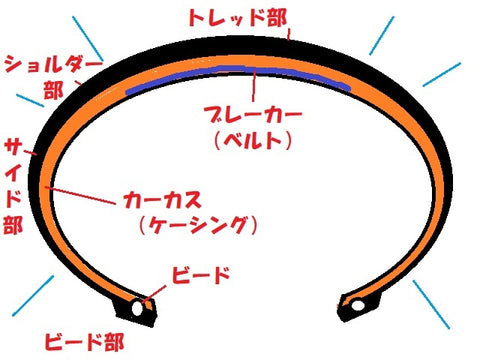
Taking the common "clincher" as an example to explain the tire structure, there is the "tread" part that contacts the ground. Due to friction with the ground, it is thicker than other parts.
The material can be natural rubber or synthetic rubber.
Incidentally, synthetic rubber is more durable.
Inside, there is a breaker (belt).
The side part that supports the tire itself is called the "carcass (casing)."
This part is a textile layer, and most tires seem to have three layers.
As elasticity is required, materials such as nylon, polyester, cotton, and aramid fiber, mainly resins, are used.
The connection part with the rim is called the bead area, and a "bead" is inside it.
You can think of the bead as a wire.
Where to find tire size
When replacing tires, you generally buy the same size as the old, worn-out tire, but you need to know where to find that information.
Please refer to the image below for tire size.
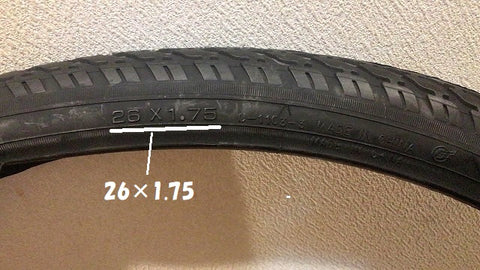
Tire Diameter (Tire Size)
"20×1 3/8" and similar notations represent the tire size.
If this doesn't match, the diameter won't fit the rim.
For reference, here are some sizes I've seen in the past.
(I've omitted any that I forgot to record or whose details are unclear.)
Sizes
"20×1.75", "24×1・3/8", "26×1.95", "26×1・3/8", "27×1・3/8", "700×23C", "700×25C", "700×28C", "700×32C", "700×35C"
Rim Width - Bead Diameter (ETRTO Standard)
Next, "37-451" or "37-438" indicates the rim width and bead diameter.
The first number, "37," is the rim width.
The subsequent numbers, "451" or "438," are the bead diameters.
If the rim width doesn't match, gaps may form, or the tire may not fit at all.
If the bead diameter doesn't match, it won't fit snugly on the rim.
ETRTO Standard
"23-622", "25-622", "28-622", "32-622", "37-540", "37-590", "37-630", "47-305", "47-355", "47-406"
Tire and Rim Shape Standards
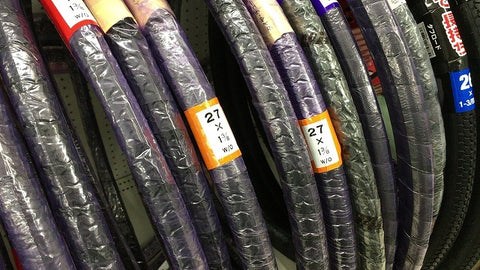
There are two types of tire and rim standards: "W/O" and "H/E."
W/O stands for "wired-on" and is a European standard, used in countries like the UK and France.
About 80% of bicycles use this standard.
Dimensions are stated in inches (fractions) or millimeters.
From what I've seen in the tire section of local home centers, all were "W/O."
This type is common for city bikes (mamachari).
They are marked with notations like "26×1 3/8."
H/E (Hooked Edge) is an American standard.
The tire is held in place by hooking a wire onto the rim.
The size notation is in inches (decimal), and I haven't seen millimeter notations for this type.
I believe it's common for mountain bikes, mini velos (small-wheeled bikes), and children's bikes.
They are marked with notations like "26×1.75."
Standards
"H/E", "W/O"
Tire Width is Customizable
When replacing tires, you generally buy the same size as the original, but you can choose wider or narrower options for the width.
If the tire is wider, the amount of air it holds increases, making tire inflation more difficult.
However, shock absorption improves, leading to a more comfortable ride.
If the tire is narrower, rolling resistance and the contact area with the ground decrease, making pedaling feel lighter.
Acceleration also increases.
Even just changing tires involves several key points to consider, and if you overlook them, you might end up choosing tires that aren't suitable for your bicycle.
Please use this article as a reference to choose the right tires for your bicycle.
1 comment
現在650p47cを装着してます。
以降、サイズ変更に悩んでいます。
ショップとしては、650b40を、進めてくれてます。 知識や技術もなく、決断に困っています。 どうしたいのか? それでも可能でそのタイヤでもいいとだと思います。 ただ、他に選択肢は、ないのだろうか?と思ってます。
簡潔ですが、何かタイヤに、たいしての参考があれば、お願いします。