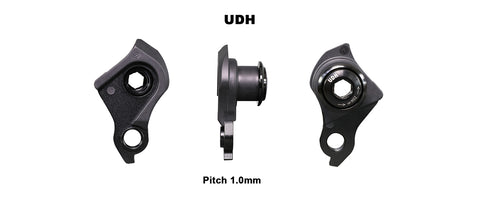
What is a UDH rear derailleur hanger?
UDH (Universal Derailleur Hanger) is an acronym for the derailleur hanger provided by SRAM, which is a component attached to a bicycle frame to mount the derailleur. Derailleur hangers come in several different designs and shapes, and a common standard has been established. UDH is a universal derailleur hanger designed to be compatible with various bicycle frames, making it a convenient option for users of SRAM products.
SRAM UDH Compatibility
Only bicycles designed around SRAM UDH are compatible with this standard.
Unlike other standards in the bike industry (e.g., bottom brackets and headsets), SRAM's UDH standard has been rapidly adopted by many brands. It was announced in 2019 and is used on many performance mountain bikes, such as the Trek Fuel EX, Scott Scale RC, and Canyon Neuron.
SRAM's website has a bike finder where you can check if your bike uses this standard.

SRAM UDH vs. Shimano Direct Mount
SRAM wasn't the first brand to attempt to unify derailleur hanger standards.
When Shimano released its Shadow-style mountain bike rear derailleurs in 2012, it introduced its direct-mount standard. This was later ported to road and gravel when the brand released Dura-Ace R9100 and GRX.
Direct mount was designed to create a stronger connection between the frame and rear derailleur, aiming to improve shifting quality. Shimano also claimed it would make wheel changes faster.
Because Shadow derailleurs sit further back, Shimano included a "B-link" to connect the rear derailleur to a conventional hanger.
With a direct mount hanger, the B-link is removed, and the rear derailleur bolts directly to the hanger.
While some aftermarket products were available to fit various bikes, the standard never gained widespread adoption.
According to a patent application filed in 2022, Shimano appears to be developing a universal derailleur hanger similar to SRAM T-Type. The patent illustrates a hanger with slots on either side of the dropout that is secured by an axle.
Features of the Universal Derailleur Hanger
SRAM's UDH is not yet truly "universal." However, numerous bike manufacturers have seemingly found value in providing a standard, simple solution to a problem that has plagued consumers for decades, and they are endorsing it.
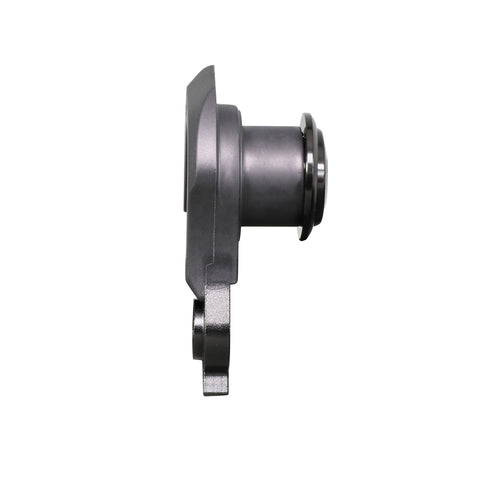
Features of the universal derailleur hanger include a lip to prevent the chain from falling into the frame, and the ability to rotate backward in the event of a significant impact.
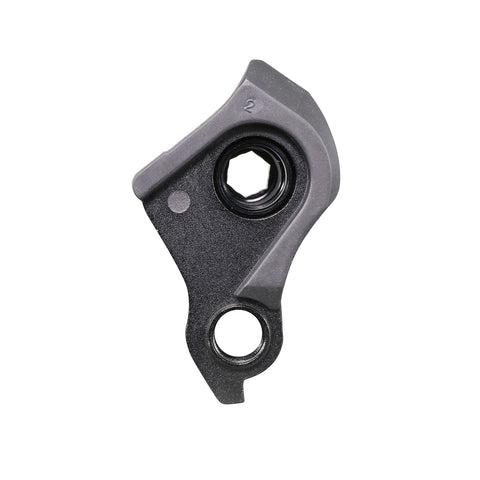
Brands that have adopted the universal derailleur hanger include major manufacturers like Trek, Giant, and Specialized, as well as other high-end manufacturers worldwide such as Canyon, Cube, Ibis, Merida, Orbea, Santa Cruz, Scott Sports, and Transition. For a complete directory of UDH-compatible bikes, refer to SRAM's extensive list.
SRAM states that the number of UDH-compatible bikes is in the hundreds and growing daily.
SRAM's design is more than just a standard derailleur hanger. It also incorporates some cool features designed to alleviate some common and frustrating problems riders experience.
First, the UDH has a lip that contacts the bike's frame, preventing the chain from dropping into the frame. Instead, it guides the chain back onto the cassette, avoiding the unpleasant grinding sound of the chain against the frame.
Second, the UDH can rotate backward under significant impact. This allows it to absorb much greater forces than a traditional fixed hanger, without breaking or sending the derailleur into the rear wheel spokes.
The importance of UDH Compatibility is a challenge in the cycling world. With an almost infinite choice of components, from cassettes and chains to shifters, bottom brackets, and hubs, it makes assembling and maintaining a bike difficult even for experienced cyclists. Creating standard components is a simple way for riders to spend more time on their bikes and less time poring over spec sheets and dimensions.
A similar thing is happening in the world of hookless rims, with many manufacturers trying to find standards that improve compatibility with what can sometimes be finicky products.
UDH has only been around for a few years. If more brands adopt it, it could eliminate a nagging problem for cyclists.


![AERO 40 Ⅱ ディスクブレーキホイール[リム内幅23mm] - ICANホイールジャパン](http://icanjp.com/cdn/shop/files/1_d90bc651-48bd-4f22-9e13-6d963c283ba6_1370x.jpg?v=1753869976)
![AERO 40 Ⅱ ディスクブレーキホイール[リム内幅23mm] - ICANホイールジャパン](http://icanjp.com/cdn/shop/files/2_37e9600e-9785-4d45-abe1-df49da71e7ee_1370x.jpg?v=1753869976)
![AERO 50 Ⅱ ディスクブレーキホイール[リム内幅23mm] - ICANホイールジャパン](http://icanjp.com/cdn/shop/files/ICANAERO50IIDiscWheels_1_1370x.jpg?v=1758088613)
![AERO 50 Ⅱ ディスクブレーキホイール[リム内幅23mm] - ICANホイールジャパン](http://icanjp.com/cdn/shop/files/ICAN_AERO_50_II_Disc_Wheels_2_1370x.jpg?v=1758088881)


![FL40Ⅱ ワイドリムロードカーボンホイール 軽量「内幅23mm] - ICANホイールジャパン](http://icanjp.com/cdn/shop/files/1_771b4686-2e73-4d35-b47c-b123b298f7f7_1370x.jpg?v=1755486826)
![FL40Ⅱ ワイドリムロードカーボンホイール 軽量「内幅23mm] - ICANホイールジャパン](http://icanjp.com/cdn/shop/files/2_76389d17-9f29-42af-aa59-a695414fcaf7_1370x.jpg?v=1755486826)