![AERO 40 Ⅱ ディスクブレーキホイール[リム内幅23mm] - ICANホイールジャパン](http://icanjp.com/cdn/shop/files/1_d90bc651-48bd-4f22-9e13-6d963c283ba6_1370x.jpg?v=1753869976)
![AERO 40 Ⅱ ディスクブレーキホイール[リム内幅23mm] - ICANホイールジャパン](http://icanjp.com/cdn/shop/files/2_37e9600e-9785-4d45-abe1-df49da71e7ee_1370x.jpg?v=1753869976)
![AERO 50 Ⅱ ディスクブレーキホイール[リム内幅23mm] - ICANホイールジャパン](http://icanjp.com/cdn/shop/files/ICANAERO50IIDiscWheels_1_1370x.jpg?v=1758088613)
![AERO 50 Ⅱ ディスクブレーキホイール[リム内幅23mm] - ICANホイールジャパン](http://icanjp.com/cdn/shop/files/ICAN_AERO_50_II_Disc_Wheels_2_1370x.jpg?v=1758088881)


![FL40Ⅱ ワイドリムロードカーボンホイール 軽量「内幅23mm] - ICANホイールジャパン](http://icanjp.com/cdn/shop/files/1_771b4686-2e73-4d35-b47c-b123b298f7f7_1370x.jpg?v=1755486826)
![FL40Ⅱ ワイドリムロードカーボンホイール 軽量「内幅23mm] - ICANホイールジャパン](http://icanjp.com/cdn/shop/files/2_76389d17-9f29-42af-aa59-a695414fcaf7_1370x.jpg?v=1755486826)
What should I do to get faster on my road bike right now?
When riding a road bike, there are times when you just want to go faster.
There are many factors that contribute to speed, but they can mainly be divided into the following three categories:
・Equipment factors
・Riding technique factors
・Physical factors
"Physical factors" require training, which inevitably takes time.
While that's something to work on, it's more satisfying to learn something today that can make you faster immediately, isn't it?
Here, I'd like to introduce "equipment factors" and "riding technique factors."
■Changing your wheels will make you dramatically faster
Changing your wheels will make you dramatically faster.
The main reason for this is "lightness."
In road cycling, "lightness is justice," but many people focus on the "frame."
However, what you should be focusing on is the "wheels."
The reason for this is the proportion of the total bicycle weight that the frame occupies.
It's not often discussed, but let's compare the weight of a typical chromoly (steel) frame, a carbon frame, an aluminum wheel, and a carbon wheel.
- Frame weight
Typical chromoly frame: 1.7-2.0 kg
Lightweight chromoly frame: 1.1-1.4 kg
Typical aluminum frame: 1.4-1.6 kg
Carbon frame: 0.8-1.1 kg
- Wheel weight
Steel wheels: 2.3 kg ~ (front 1.0 kg ~, rear 1.3 kg ~)
Aluminum wheels: 1.5 kg ~ (front 0.7 kg ~, rear 0.8 kg ~)
Carbon wheels: 1.3 kg ~ (front 0.6 kg ~, rear 0.7 kg ~)
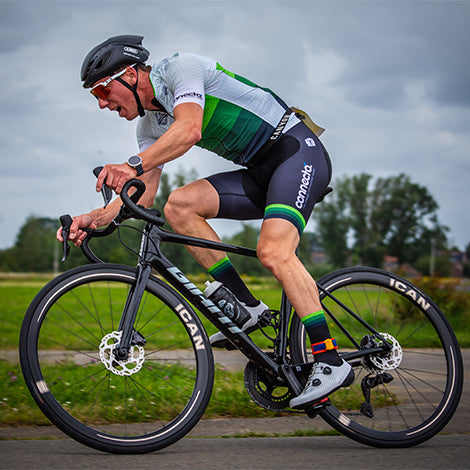
Even with a simple comparison, wheels are heavier than frames.
There isn't much data comparing frame and wheel weights by material, so even the above information is fairly niche, but let's delve even deeper into the niche.
When a chromoly frame is combined with steel wheels (often called "steel clogs"), the proportion of the wheel weight is 39-43%.
Considering the proportion of the entire bicycle (approximately 9 kg), it becomes 26%.
If the frame is aluminum or carbon, using steel wheels makes the wheels even heavier.
If the entire bicycle is considered to be around 6 kg, then approximately 40% of that weight is due to the wheels.
You will feel the effect more by replacing the wheels than by replacing the frame.
■Replacing wheels adds an aero effect
Some carbon wheels have a high-design aesthetic and high aerodynamic performance.
Often seen in triathlons, aero road bikes are designed to the extreme to counter road and air resistance.

Just by reducing air resistance, the pedals become significantly lighter.
You probably feel the pedals getting heavy when riding against a headwind, so it's easy to understand if you think of it as the opposite.
Increase cadence and shift from "pedaling" to "spinning"
Understanding riding technique elements allows for immediate improvements.
When first starting out on a road bike, people often ride in a heavy gear at a low cadence, similar to a city bike.
"Cadence" refers to RPM, or revolutions per minute, in automotive terms.
If you use a heavy gear, you can go fast even with a low pedal rotation speed.
However, for road cycling, it's more advantageous to use a high cadence and spin the pedals quickly.
If you have a cadence sensor, aim for around 90-100 rpm.
By the way, rpm is a unit that indicates how many revolutions per minute.
Since one minute is 60 seconds, think of high cadence as spinning the pedals faster than one revolution per second.
"Pedaling" can feel heavy with each stroke, gradually becoming lighter.
It's easy to think this is a faster and easier way to ride, but it only uses the inner thigh muscles, and you're always using the same muscles.
While it's fine for commuting to work or school, if you try to ride a medium distance (50km or more), you'll be exhausted.
On the other hand, "spinning" involves using a lighter gear and spinning faster, so each stroke isn't as heavy.
When you first change your pedaling style, you might feel muscle soreness because you're using muscles you haven't used before, but you'll gradually get used to it and be able to handle medium and long distances.
Stop dancing and conserve energy
When climbing a hill, people tend to climb by dancing.
Just in case, dancing is a riding style where you lift your bottom off the saddle and sway your body from side to side while pedaling uphill.
In short, it's "standing pedaling."
If you adopt the high-cadence riding style mentioned above, you should be able to climb hills while sitting (keeping your bottom on the saddle).
Dancing is effective, but it uses a lot of overall physical energy.
When riding long distances, it becomes a significant factor in energy depletion.
By riding in a sitting position as much as possible, you can conserve energy and ride fast and energetically until the end.
Summary
First, if you want to get faster on your road bike immediately, start by replacing your wheels with lighter ones.
Wheels make up a significant portion of the total weight of a bicycle.
Compared to frames, they are cheaper and heavier, so replacing them offers a great cost-benefit.
Next, by using a lighter gear than usual and riding at a high cadence, you engage various leg muscles and prevent fatigue.
Try changing your riding style from heavy "pedaling" to light, powerful "spinning."
Finally, avoid dancing as much as possible.
Dancing is effective when climbing hills, but it's a double-edged sword that drains a lot of energy.
By riding in a sitting position as much as possible, you will be able to ride fast and energetically until the end.