![AERO 40 Ⅱ ディスクブレーキホイール[リム内幅23mm] - ICANホイールジャパン](http://icanjp.com/cdn/shop/files/1_d90bc651-48bd-4f22-9e13-6d963c283ba6_1370x.jpg?v=1753869976)
![AERO 40 Ⅱ ディスクブレーキホイール[リム内幅23mm] - ICANホイールジャパン](http://icanjp.com/cdn/shop/files/2_37e9600e-9785-4d45-abe1-df49da71e7ee_1370x.jpg?v=1753869976)
![AERO 50 Ⅱ ディスクブレーキホイール[リム内幅23mm] - ICANホイールジャパン](http://icanjp.com/cdn/shop/files/ICANAERO50IIDiscWheels_1_1370x.jpg?v=1758088613)
![AERO 50 Ⅱ ディスクブレーキホイール[リム内幅23mm] - ICANホイールジャパン](http://icanjp.com/cdn/shop/files/ICAN_AERO_50_II_Disc_Wheels_2_1370x.jpg?v=1758088881)


![FL40Ⅱ ワイドリムロードカーボンホイール 軽量「内幅23mm] - ICANホイールジャパン](http://icanjp.com/cdn/shop/files/1_771b4686-2e73-4d35-b47c-b123b298f7f7_1370x.jpg?v=1755486826)
![FL40Ⅱ ワイドリムロードカーボンホイール 軽量「内幅23mm] - ICANホイールジャパン](http://icanjp.com/cdn/shop/files/2_76389d17-9f29-42af-aa59-a695414fcaf7_1370x.jpg?v=1755486826)
How to Fit a Road Bike
You’ve just bought a road bike off the internet, and everyone tells you that you need to get a proper fitting. The problem is that you don’t have the money for professional equipment. So let us guide you and help you.
There are some caveats here, if you are injured, and you are worried you will aggravate it, then you need to go and see a doctor and get the professional advice you need. The second caveat is that bicycle fitting is all about parameters.

Road bikes are more important than other types of bikes. The reason for this is that you tend to stay in the same position for a longer time on a road bike than you would on other forms of bicycles. Also, you will be riding at a higher cadence, and your body will quickly tell you if your knee extension is wrong.
Always listen to your body, and it will guide you to a good bike fit. There is the old rule about knee pain on the ball of the foot, too far forward, and your saddle is too low. However, this is just a guideline. However, one of the most common mistakes is that many road cyclists have their saddle too high. Perhaps they want to look like the pros riding in a high position.
Bike Fit Angle
It is about putting your body into a safe set of angles where the biomechanics of your joints work well. There is no right or wrong angle. In fact, your bike fit angles can change over the course of a week. If you have been sat at your desk for a whole week, you can’t expect your body to be in a riding position.
As you get older, your bike fit will change. When you gain fitness, or you lose fitness. Just riding your bike, and your body adapts to it, so things will change. If you trip over something and hurt your hip a bit more, it will change. This means that while you can use your bike fit from last year as a base, be aware that things may have changed.
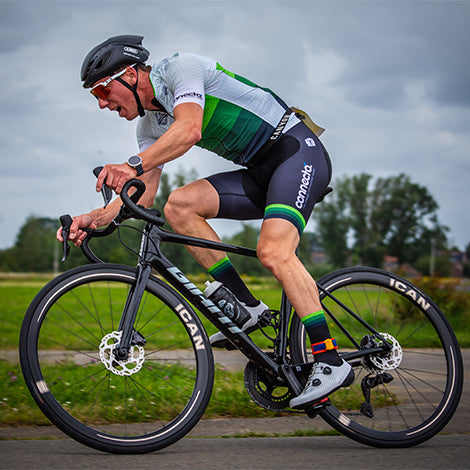
The easiest way to get your bike to fit at home is by using an app and a turbo trainer. There is an iOS app called Bike Fit Fast. It’s a shame they don’t do an Android version, but it does a fantastic job. The other thing you will need are some bright colored stick-on dots, and these help the app with its accuracy by placing them in the correct spots.
Road Bike Pedals
Once you’ve set all this up, you’ll want to be honest with yourself. Taking up a race position that your body can’t support is one of the worst things you can do. It won’t be a fast position. For many people, a more comfortable position will be a faster position.
First of all, let’s start by looking at your feet. You will want to get your cleat set up precisely on your spike; otherwise, you start at a flawed start to looking at your bike. The thing to remember is that your spikes and pedals have float. Float is the amount of rotational movement from the center that your spike and cleat will allow. If you have bad knees, then you want a higher amount of float. This allows your body to correct for small errors. A zero-float does not allow this so you have to have your cleats spot on.
The reason that float is good is that when you pedal your knee doesn’t just go up and down, it twists. This will affect your foot/ankle rotation and pronation. Running 0-degree spikes significantly reduces the degree of movement your body needs to achieve this. People who use 0-degree cleats have more knee problems than those who use float.
The general way to set your cleat fore and aft is to take your first metatarsal and your fifth metatarsal, the first bony protrusion on the outside of your foot, and line up the spindle of your pedal to bisect these two points. You can change from this position. A more forward position can cause issues with your Achilles tendon. A more rearward cleat position helps to spread the pressure created when pedaling more easily. Placing your cleat here can alleviate hot feet (forefoot pain). Triathletes also like this as it helps when they have to get off the bike and run a marathon.
In addition to all of this, you’ll want to check yourself walking in a mirror. This will help you to get your cleats sorted out. If you walk with your toes pointing forward, then you’ll need to set up your spikes to mimic this when you are on your bike. If you walk with your toes pointing out or with your heels in, then your spikes need to be set up to mimic this, and you also need to ensure that your heel doesn’t catch the chainstay when you bring your foot through. Here you would angle the cleat inwards towards your shoe, moving it back a little. If you are pigeon-toed, you would need to angle your heel out a bit.
So now you’ve got your cleats sorted, and you know how to add some angle parameters to the rest of the positions. Bike FitFast makes this a lot quicker and easier than using a goniometer and getting a friend to help you. Here is a cheat sheet:
Hip angle - 55-70°
Elbow angle - 150-160°
Knee angle range - 35-40°
Road bike saddle height
To start this process, you need to get your saddle height right. Over the years I have found the Greg Lemond method to be a great place to start with your fit. For this, you will need a book and a measuring tape. Stand flat against a wall. Place a book between where it may cause some discomfort if you continue going upwards. Drop the measuring tape from the book to the floor and measure the distance. It might be easier if someone helps you. I also measure in centimeters.

You then multiply this figure by 0.883 and set your saddle to this height. Measure from the center of your bottom bracket. You then take 3mm off for your cycling shoes and spikes. The position means that when your pedals and crank are at the bottom of the pedal stroke, your knee angle should be between 35 and 40 degrees.
Here’s a tip to check if this angle is correct. Sit on your bike, put your pedals at 3 and 9 o’clock, and let your feet hang loose. Look at them or get a video or picture on your phone. Look at your feet, this is where they will naturally want to sit. They will be slightly bent. Not perfectly straight. This should look the same when you pedal.
If the position feels weird, try to move it up or down in small increments. Don’t hold the same position when it hurts.
Road Bike Handlebar Height
Now if you use the app I recommended, then getting your handlebars set up is a bit easier. It is a bit problematic if you don’t have a helping hand. There is no really cunning way other than by feel. If your first road bike starts from the highest position, set your reach and handlebar height to be the same as your old bike.