![AERO 40 Ⅱ ディスクブレーキホイール[リム内幅23mm] - ICANホイールジャパン](http://icanjp.com/cdn/shop/files/1_d90bc651-48bd-4f22-9e13-6d963c283ba6_1370x.jpg?v=1753869976)
![AERO 40 Ⅱ ディスクブレーキホイール[リム内幅23mm] - ICANホイールジャパン](http://icanjp.com/cdn/shop/files/2_37e9600e-9785-4d45-abe1-df49da71e7ee_1370x.jpg?v=1753869976)
![AERO 50 Ⅱ ディスクブレーキホイール[リム内幅23mm] - ICANホイールジャパン](http://icanjp.com/cdn/shop/files/ICANAERO50IIDiscWheels_1_1370x.jpg?v=1758088613)
![AERO 50 Ⅱ ディスクブレーキホイール[リム内幅23mm] - ICANホイールジャパン](http://icanjp.com/cdn/shop/files/ICAN_AERO_50_II_Disc_Wheels_2_1370x.jpg?v=1758088881)


![FL40Ⅱ ワイドリムロードカーボンホイール 軽量「内幅23mm] - ICANホイールジャパン](http://icanjp.com/cdn/shop/files/1_771b4686-2e73-4d35-b47c-b123b298f7f7_1370x.jpg?v=1755486826)
![FL40Ⅱ ワイドリムロードカーボンホイール 軽量「内幅23mm] - ICANホイールジャパン](http://icanjp.com/cdn/shop/files/2_76389d17-9f29-42af-aa59-a695414fcaf7_1370x.jpg?v=1755486826)
Is it better to have a larger or smaller frame size?
For road bikes, it's common to buy individual parts for each section.
When choosing a frame, you need to select the size based on your height.
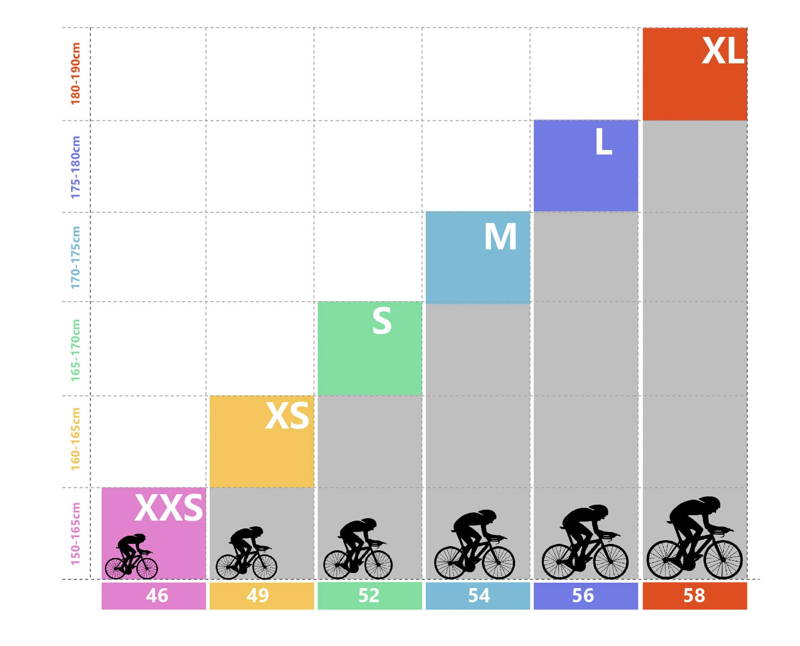
Sizes are often chosen based on height as follows:
150cm~165cm: XXS
160cm~165cm: XS
165cm~170cm: S
170cm~175cm: M
175cm~180cm: L
180cm~190cm: XL
This often leads to questions.
The author is 175cm tall, so according to the options above, should they choose M or L?
It's surprisingly unclear whether a larger or smaller frame size is better.
Let's summarize the advantages and disadvantages of each and decide which is better.

What happens if the frame is small?
Let's consider what happens if you choose a frame that is too small for your body.
・Lighter weight
・Handlebars are closer
・Handlebars are lower
・Quick handling
・Higher rigidity
When choosing a smaller frame for your body, you'll experience the things listed above.
Being smaller, it will naturally be lighter in weight.
This could be considered its biggest advantage.
Since it's a smaller frame, the handlebars will naturally be closer.
The handlebars being closer is even sought after by professional athletes who intentionally choose smaller frames, so it can be considered an advantage.
Lower handlebars result in a lower center of gravity.
This can also be considered an advantage.
Quick handling means it's nimble, agile, and sharp.
In cycling, this can also be considered an advantage.
Regarding rigidity, it might be hard to understand that a smaller frame has higher rigidity.
Imagine a short rod and a long rod made of the same material.
You can intuitively understand that the longer rod is easier to bend than the shorter one.
In other words, a smaller bike frame has higher rigidity.
Higher rigidity means it's less likely to break and has a higher chance of lasting longer.
The possibility of the frame flexing or bending when force is applied is reduced.
These would be classified as advantages, rather than disadvantages.
Conversely, there are no particular disadvantages to be found.
While the circumstances remain the same, whether they are considered advantages or disadvantages depends on the user.
When the frame size is small, you might think that your knees never fully extend during pedaling.
If your knees are constantly bent, you can't transfer enough power to the bike.
However, this can be resolved by extending the seat post to raise your hip point (seat point).
This is not a disadvantage.
What happens if the frame is large?
Now let's consider the opposite case, when the frame is large.
If the frame is large, in the worst-case scenario, there's the biggest disadvantage of your feet not reaching the pedals.
Even during pedaling, if your feet can't reach certain points, you won't be able to apply power.
These are the top dead center and bottom dead center, the highest and lowest points.
In this case, there's no fundamental solution other than to grow taller.
There are temporary solutions like wearing thick-soled shoes, but wearing thick soles also has disadvantages, such as making it harder to transfer power.
Points to note
From the above, we've learned that a smaller frame size is better than one that's too large.
This is because there are definitely more advantages than disadvantages.
However, while a slightly smaller size is good, "too small" is actually not good.
Specifically, since the author is 175cm tall, debating between M and L is a matter of personal preference, so either choice is fine.
However, choosing S or XS just because you heard smaller is better is going too far.
It simply becomes harder to pedal.
The handlebars become too low and difficult to grip.
The above disadvantages can arise.
To some extent, it might be possible to adjust with the stem (the vertical part of the handlebars) and the steerer tube (the horizontal part of the handlebars).
However, overdoing it can worsen maneuverability, and above all, it can look bad.
Summary
Frame size is chosen based on height.
It's best to choose based on the manufacturer's recommended size. If you're debating between a size slightly above or below your height's midpoint, choosing the smaller one is likely to offer more advantages and greater satisfaction.
On the other hand, if you go one or two sizes down from your appropriate size, disadvantages will emerge, so going too small is also not good.