![AERO 40 Ⅱ ディスクブレーキホイール[リム内幅23mm] - ICANホイールジャパン](http://icanjp.com/cdn/shop/files/1_d90bc651-48bd-4f22-9e13-6d963c283ba6_1370x.jpg?v=1753869976)
![AERO 40 Ⅱ ディスクブレーキホイール[リム内幅23mm] - ICANホイールジャパン](http://icanjp.com/cdn/shop/files/2_37e9600e-9785-4d45-abe1-df49da71e7ee_1370x.jpg?v=1753869976)
![AERO 50 Ⅱ ディスクブレーキホイール[リム内幅23mm] - ICANホイールジャパン](http://icanjp.com/cdn/shop/files/ICANAERO50IIDiscWheels_1_1370x.jpg?v=1758088613)
![AERO 50 Ⅱ ディスクブレーキホイール[リム内幅23mm] - ICANホイールジャパン](http://icanjp.com/cdn/shop/files/ICAN_AERO_50_II_Disc_Wheels_2_1370x.jpg?v=1758088881)


![FL40Ⅱ ワイドリムロードカーボンホイール 軽量「内幅23mm] - ICANホイールジャパン](http://icanjp.com/cdn/shop/files/1_771b4686-2e73-4d35-b47c-b123b298f7f7_1370x.jpg?v=1755486826)
![FL40Ⅱ ワイドリムロードカーボンホイール 軽量「内幅23mm] - ICANホイールジャパン](http://icanjp.com/cdn/shop/files/2_76389d17-9f29-42af-aa59-a695414fcaf7_1370x.jpg?v=1755486826)
What's the difference between a road bike and a mamachari? -> They're completely different vehicles.
Many people seem to change their mode of transportation when their lifestyle changes. With the recent boom in cycling and health consciousness, bicycles can be said to be a 주목할만한 mode of transportation.
The push by national and prefectural governments to improve dedicated cycling paths is also a factor.
If you're going to ride, you might as well ride a cool sports bike, but for a first-time sports bike owner, you might be curious about what makes it different from the bicycles you've ridden before.
So, I've summarized the differences between sports bikes (road bikes) and utility bikes (mamachari).
■ Difference in Weight
I believe the biggest and most impactful difference is weight.
A typical mamachari weighs about 15-20 kg.
In contrast, a sports cross bike weighs about 10-13 kg.
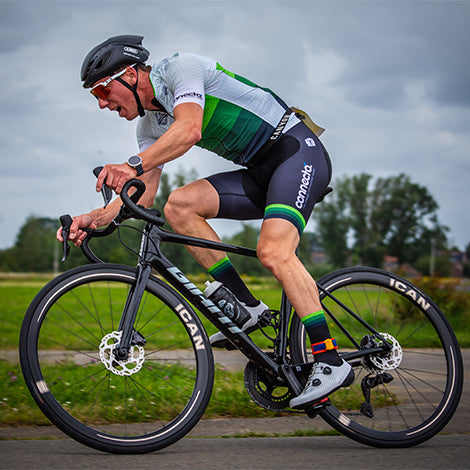
Road bikes can even be as light as 6-10 kg, about half the weight of a mamachari.
Many people who are used to mamachari might wonder, "What's so good about being light?"
This lightness dramatically reduces the effort needed to pedal, making the bike easier to move forward.
In other words, if you pedal with the same amount of force as a mamachari, you can ride faster and cover longer distances with less effort.
■ Difference in Frame Shape
Globally, common bicycle frames are triangular.
This is called a "truss structure," which makes it easy to achieve strength by using a triangular shape.
This is also used in building construction, which speaks to its reliability.
On the other hand, as far as I've researched, the mamachari seems to be unique to Japan.
While the distinctive truss structure easily creates a strong shape, it requires the rider to straddle the frame when getting on the bicycle, necessitating lifting one's leg high.
As the name suggests, the mamachari was developed for women, especially mothers.
By eliminating the top tube of the frame and instead reinforcing the V-shape in place of the missing horizontal bar, strength was maintained.
Prioritizing ease of mounting without sacrificing strength resulted in a heavier frame.
This might have been based on the idea that mothers would only use their bikes for short shopping trips around the neighborhood, even if it meant a slightly heavier bike.
While we live in an age of diversity now, the mamachari's prototype was developed around 1975, more than 50 years ago.
Today, many women also ride sports bikes, so it's best to choose a bike you like, one that fits your lifestyle, and one that suits you.

■ Tire Size and Width
Sports bikes like road bikes have a nearly standardized tire (wheel) size.
The wheel size for sports bikes is 700c, which is equivalent to about 27 inches in a mamachari.
Even with the same wheel size, frames themselves come in detailed sizes, and you choose one that fits you based on your height.
Manufacturers seem to display sizes differently, with some dividing them into about 8 stages based on height, and others using classifications like SS, S, M, L, XL.
Choosing a sports bike like a road bike means prioritizing design and finding one that suits you.
On the other hand, mamachari are usually chosen from sizes like 20, 24, 26, or 27 inches.
You'd likely choose a wheel size and then select based on whether both feet can touch the ground when you're seated.
It's rare to find the same design in both 20-inch and 24-inch versions; with mamachari, the choice is often driven by size, with design being less of a priority.
■ Difference in Number of Gears
The number of gears differs dramatically between sports bikes and mamachari.
Mamachari sometimes don't have gears at all, and even if they do, 5 or 6 speeds are common.
Since they're not designed for long distances, mamachari riders typically don't pay much attention to whether the initial pedal stroke is heavy or light.
Road bikes typically have 12 gears on the rear wheel and 3 on the crankset (chainrings).
This means you can shift through 3 front gears × 12 rear gears = 36 speeds.
This allows you to use your preferred gear.
For those accustomed to mamachari, you might wonder, "Why do I need so many gears?"
Even with 36 gears, not many people use all of them.
You use different gears for starting, climbing hills, or riding fast and easily when you've built up speed.
With a mamachari, haven't you ever wished for a stronger gear when accelerating, only to find it too strong after shifting, and then had to shift back down?
With a road bike, it's perhaps better to think that you'll have just the right gear for yourself.
■ Difference in Handlebars
Mamachari have unique M-shaped handlebars.
There's only one gripping spot on each side.
On the other hand, road bikes have handlebars with a distinctive shape called drop handlebars.
While unimaginable from a mamachari perspective, there are at least three gripping points (places to hold), and you can hold them in even more different ways.
While it's common to hold the same spot with both your right and left hands, being able to hold different spots allows you to change your hand position depending on your ride, which makes it more comfortable.
When you want to ride fast, you grip the points that make it easy to adopt a forward-leaning posture.
When you want to slow down and ride comfortably, you sit up, so you might grip the straight sections of the handlebars.
■ Lack of Unnecessary Accessories
Things that are standard on a mamachari and considered normal are often absent on a road bike.
Fenders, dynamos, carriers, baskets, kickstands, and so on.
Some people might wonder why these are sold separately for an expensive bike.
For a road bike, which is specialized for riding easily, fast, and far, anything that adds weight is considered unnecessary.
Some cross bike riders do add fenders or baskets.
The beauty of a sports bike is that you can customize everything to your convenience.
■ Conclusion
It's probably easier to understand sports bikes like road bikes and cross bikes as being similar to mamachari but ultimately different types of vehicles.
Most people recognize that bicycles and motorcycles are different vehicles, even though they both have two wheels.
Similarly, it's easier to understand road bikes and mamachari as distinct vehicles.
Ultimately, a road bike is a vehicle designed for riding easily, fast, and for long distances.
External Writer: Koichi Okuno