![AERO 40 Ⅱ ディスクブレーキホイール[リム内幅23mm] - ICANホイールジャパン](http://icanjp.com/cdn/shop/files/1_d90bc651-48bd-4f22-9e13-6d963c283ba6_1370x.jpg?v=1753869976)
![AERO 40 Ⅱ ディスクブレーキホイール[リム内幅23mm] - ICANホイールジャパン](http://icanjp.com/cdn/shop/files/2_37e9600e-9785-4d45-abe1-df49da71e7ee_1370x.jpg?v=1753869976)
![AERO 50 Ⅱ ディスクブレーキホイール[リム内幅23mm] - ICANホイールジャパン](http://icanjp.com/cdn/shop/files/ICANAERO50IIDiscWheels_1_1370x.jpg?v=1758088613)
![AERO 50 Ⅱ ディスクブレーキホイール[リム内幅23mm] - ICANホイールジャパン](http://icanjp.com/cdn/shop/files/ICAN_AERO_50_II_Disc_Wheels_2_1370x.jpg?v=1758088881)


![FL40Ⅱ ワイドリムロードカーボンホイール 軽量「内幅23mm] - ICANホイールジャパン](http://icanjp.com/cdn/shop/files/1_771b4686-2e73-4d35-b47c-b123b298f7f7_1370x.jpg?v=1755486826)
![FL40Ⅱ ワイドリムロードカーボンホイール 軽量「内幅23mm] - ICANホイールジャパン](http://icanjp.com/cdn/shop/files/2_76389d17-9f29-42af-aa59-a695414fcaf7_1370x.jpg?v=1755486826)
What's the difference between expensive and cheap cross bikes?
It is said that people compare six factors.
These are color, shape, pattern, function, size, and price.
Among them, price is a major factor, so you might find cheap bicycles attractive.
However, there is no way to measure "quality for price," so you can't tell if a bike was a good value for the price.
Here are my impressions after actually buying and riding a cross bike in the 20,000-yen range.
Weak plating and coating
First, I must tell you about the plating and coating.
Plating is a process where a metal with a different composition is used to alter the surface of another metal.
To put it simply, it's like "beautiful rust."
Coating usually involves applying a thin layer of resin or other material to the surface. Clear coating is also a type of coating, which might make it easier to understand.
Given this, you start to notice the weakness of the plating and coating about a month after you start riding.
For those with a bit of expertise, the plating's thinness or imperfection is immediately obvious, but at my level, I can't tell if the plating is thin or not pretty.
However, it quickly becomes apparent when the coating is thin.
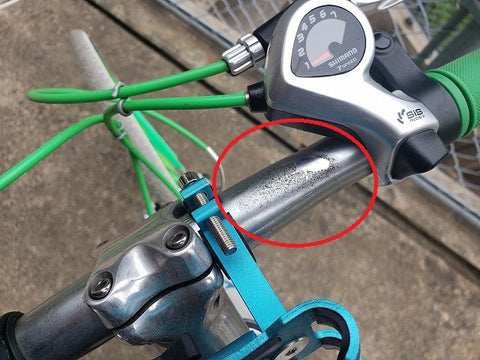
I rode it without doing anything to it and without exposing it to rain, but the coating started to peel off and turn black in just about a week.
I didn't even touch it, but it quickly became dirty.
This could probably be removed by sanding, but then the coating would be gone, so I would have to re-coat it myself.
Also, it would be the worst if I accidentally removed the plating while sanding.
The silver part in the photo is probably "nickel plating," which generally has a plating thickness of about 30 μm. Scratches made with sandpaper would be about 50 μm to 100 μm.
Since μm is not a very common unit, to add a bit of context, the thickness of a single strand of hair is about 60 μm to 80 μm.
μm was formerly called "micron," so some people might be more familiar with that term.
Even if you take good care of it, these things happen naturally because cheap parts are used.
Prone to rust
As mentioned above, thin plating leads to rust.
This is a sprocket, and it rusts quickly even with oil applied.
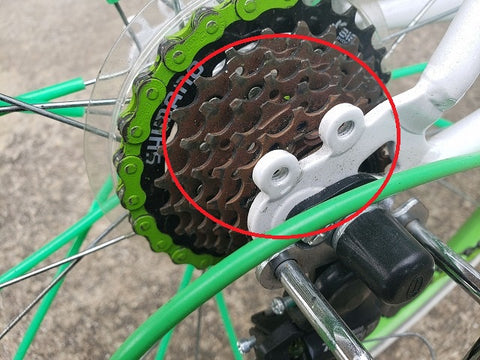
There's only one sprocket with "SHIMANO" written on it in the back.
This is probably a Shimano product.
The ones in front of it are from other manufacturers.
Shimano products seem to have a certain level of performance even if they are cheap, as they hardly rust under the same conditions.
In contrast, the sprockets closer to the front are uniformly rusty.
Poor initial setup
Although it probably depends on the shop or factory, there's a recurring mindset that as long as it's assembled, it's good enough.
One example is the adjustment of the derailleur.
If I didn't adjust it myself, it wouldn't settle into a good position, and the sound of the chain rubbing against the sprocket was quite bothersome.
Next, the brakes didn't work very well.
I disassembled and reassembled them myself.
It was too scary to ride as it was.
It seems that the sound from the crank axle won't stop completely unless it's completely disassembled once.
I mentioned stopping the noise in a previous article, but it was only temporary.
It seems that the noise won't stop without thorough intervention.
Also, I'm not sure if this counts as initial setup, but sometimes the bolts are excessively long.
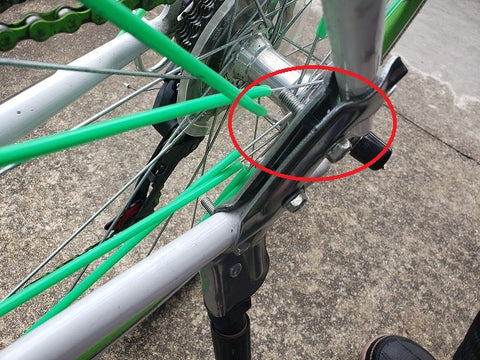
There's nothing good about excessively long bolts.
They can become protrusions that damage parts, clothing, or even injure you.
You'll need to go buy bolts of the appropriate length and re-tighten them.
Low-grade parts
The grade of the parts is uniformly low.
For example, Shimano brakes come in various grades, from highest to lowest: DURA-ACE, ULTEGRA, 105, TIAGRA, SORA, CLARIS, and so on.
If you compare only the price of brake pads between DURA-ACE and CLARIS, DURA-ACE would be 20,000 yen and CLARIS would be 2,000 yen.
There was already a 10-fold price difference.
Since bicycles naturally have front and rear brakes, there was an overwhelming price difference of 40,000 yen versus 4,000 yen for just the brake pads.
Brakes are considered good if they are 105 or higher, so if you check the price of just the 105 brake pads, it seems to be around 8,000 yen.
Of course, the frame also has a price difference depending on the material, but beyond that, each individual part has differences in quality and price.
As a result, bicycles are divided into low-quality products that rust quickly and are poorly maintained just by being left alone, and reliable products made with high-end materials that are properly assembled.
And if you choose a somewhat decent product, you might actually lose money if you don't choose a road bike around 100,000 yen, or a cross bike around 50,000 to 80,000 yen.
Poor quality parts
Looking at the quality of bolts and other parts, thin plating is often used, leading to quick rusting.
Of course, applying oil every time can help to some extent. However, in reality, I don't think most people would do that, so rust occurs quite frequently.
What struck me about ICAN's finished products was the good quality of the parts. I was impressed that many of them were made by Shimano.
Please take a close look yourself.

Carbon wheels in ICAN's Japan warehouse category
Conclusion
There's a reason why cheap bikes are cheap.
For bikes you ride every day, I recommend getting a reasonably good one.
That way, you'll grow more attached to it and can ride it in good condition for a long time.
Guest Writer: Koichi Okuno