![AERO 40 Ⅱ ディスクブレーキホイール[リム内幅23mm] - ICANホイールジャパン](http://icanjp.com/cdn/shop/files/1_d90bc651-48bd-4f22-9e13-6d963c283ba6_1370x.jpg?v=1753869976)
![AERO 40 Ⅱ ディスクブレーキホイール[リム内幅23mm] - ICANホイールジャパン](http://icanjp.com/cdn/shop/files/2_37e9600e-9785-4d45-abe1-df49da71e7ee_1370x.jpg?v=1753869976)
![AERO 50 Ⅱ ディスクブレーキホイール[リム内幅23mm] - ICANホイールジャパン](http://icanjp.com/cdn/shop/files/ICANAERO50IIDiscWheels_1_1370x.jpg?v=1758088613)
![AERO 50 Ⅱ ディスクブレーキホイール[リム内幅23mm] - ICANホイールジャパン](http://icanjp.com/cdn/shop/files/ICAN_AERO_50_II_Disc_Wheels_2_1370x.jpg?v=1758088881)


![FL40Ⅱ ワイドリムロードカーボンホイール 軽量「内幅23mm] - ICANホイールジャパン](http://icanjp.com/cdn/shop/files/1_771b4686-2e73-4d35-b47c-b123b298f7f7_1370x.jpg?v=1755486826)
![FL40Ⅱ ワイドリムロードカーボンホイール 軽量「内幅23mm] - ICANホイールジャパン](http://icanjp.com/cdn/shop/files/2_76389d17-9f29-42af-aa59-a695414fcaf7_1370x.jpg?v=1755486826)
Which is stronger, a carbon frame or an aluminum frame?
It seems there's a debate about which is stronger: carbon frames or aluminum frames.
However, when you look into it, there's a mix of correct and incorrect information.
The author of this article is a mechanical designer, though not for bicycles.
Therefore, they have fundamental knowledge of materials and extensive experience with design failures.
This author intends to expose the truths and falsehoods about the strength of carbon and aluminum frames.
We will also consider steel frames, which are likely the most common on the market, so we hope this information is helpful.

Pure Materials Are Not Practical
First, it's important to understand that while we talk about "iron," "aluminum," or "carbon," the general public rarely sees pure (single) materials.
Let's start with "iron." The material commonly used in bicycles is chromium-molybdenum steel.
This is an "alloy" of iron with chromium and molybdenum melted into it.
While it is iron, an alloy is called "steel."
In the bicycle industry, it's known as "chromoly."
It has superior properties compared to pure iron.
Stainless steel is a well-known alloy containing chromium, but in chromoly, chromium is used for material reinforcement rather than in amounts sufficient to prevent rust.
In the materials industry, it's called "SCM," and even within chromoly, there are 11 types that I know of.
When making a "comparison," it's crucial to know what exactly is being compared. Therefore, broad information like "iron vs. aluminum" should not be considered highly credible.
Specific information, such as "comparing SCM 415 (chromoly) and A7075 (super duralumin)," is highly credible.
Next, aluminum is also always used in alloy form.
There are types ranging from 1000 series to 8000 series, which are alloys of aluminum as a base with various metals like copper (Cu), manganese (Mn), silicon (Si), magnesium (Mg), zinc (Zn), and nickel (Ni).
The 2000 series is easy to weld, so it should be used for stems and similar parts.
For frames, considering cost and durability, the 6000 series is likely used, while for lightweight bicycle series, the more expensive 7000 series might be employed.
Finally, carbon is also not used alone.
The "carbon" generally used in bicycles is CFRP (Carbon Fiber Reinforced Plastics), which translates to "carbon fiber reinforced plastic" in Japanese.
The carbon part is important, but the plastic part is also crucial, and even within "carbon," prices and strengths vary widely.
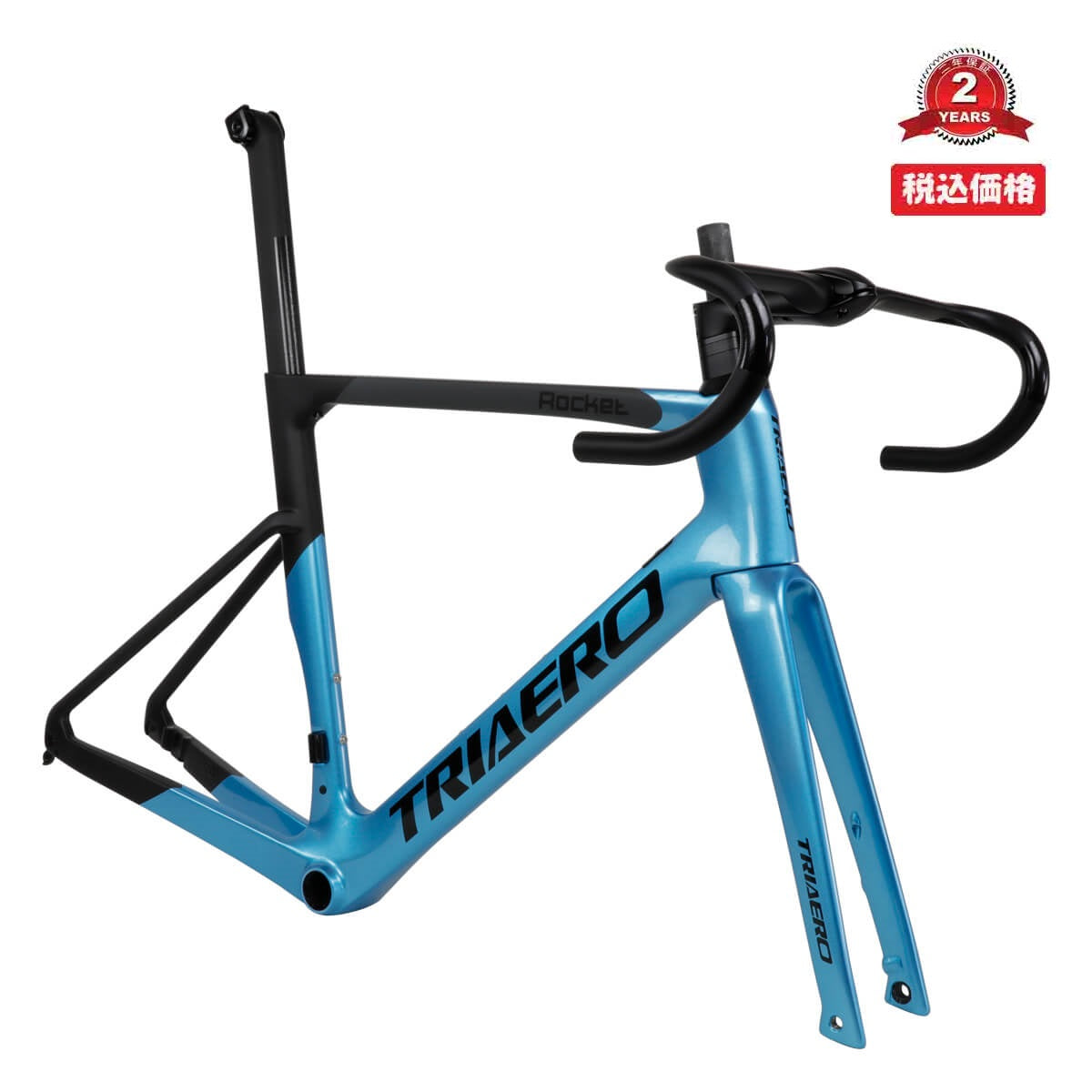
The "carbon" used by ICAN is 100% "Toray T700/T800 Carbon Fiber" from the Japanese manufacturer Toray.
Since it needs to be a material from a reliable material manufacturer, this can be considered a top-tier material globally.
The frame manufacturing process is publicly available on YouTube, and you might be surprised to see it.
So much of it is done by hand.
It's Impossible to Compare Identical Shapes
It's 100% impossible to make frames of exactly the same shape from steel, aluminum, and carbon.
Moreover, it would be pointless to do so.
Since each material has different characteristics, they wouldn't be made in exactly the same shape.
You wouldn't try to weld materials that can't be welded, and if you made carbon and steel frames in the same shape, even though carbon is three times stronger, the carbon frame would be excessively strong.
That's why I couldn't find any comparison experiments with identical shapes across any websites worldwide.
Most common experiments compare frames released by manufacturers.
Welds Vary by Manufacturer
There is no such thing as a typical "steel frame."
This is because manufacturing techniques and methods vary by manufacturer.
Looking at research results for bicycle frame durability tests, breakage usually occurs in the following areas:
- Breakage in distinctive parts
Breakage often occurs in distinctive areas, such as where the frame is thin or bent at a sharp angle.
- Welds between different materials
Although not typically done, parts where iron is welded to stainless steel, or iron to aluminum, tend to break easily.
While iron welding is common and reliable, aluminum welding is quite difficult, and welds can break.
Explaining its difficulty would fill an entire book, but I will omit it here to stay on topic.
- Bottle cage screw holes
Frames have screw holes for attaching bottle cages, right?
It seems breakages can also occur there.
- Stress concentration due to design aesthetics
In business, design is very important.
If it's not cool, it won't sell.
However, sometimes designs that are too cool can lead to stress concentration, making those areas weak.
■ Limited test data exists
There is existing data comparing "iron," "aluminum," and "carbon" frames, where various manufacturers' frames were purchased and tested.
I will refrain from providing direct links without permission, but experiments like those by "EFBe (Engineering for Bikes)" published in a German magazine are very beneficial, I believe.
They recorded frame distortion when a mechanical load (122 kg), simulating a 85 kg person standing and pedaling, was applied 100,000 times.
The company seems to believe that standing and pedaling puts the most stress on a frame.
From these results, regardless of the material, excellent frames withstood 100,000 cycles, while inferior ones broke somewhere.
The evaluation of each material in this test was as follows:
Steel frames: Not lightweight, but an attractive price with reasonable durability.
Aluminum frames: Very stiff, light, and very durable.
Carbon frames: The most durable. The lightest frames in the experiment.
This is the conclusion.
The above experiment seemed to assume 20,000 hours of use.
That's about 7 years if you were standing and pedaling for 8 hours a day.
Even professional racers wouldn't use their bikes that intensely.
For general use, none of them would break quickly, regardless of which you choose.
However, I believe it's necessary to buy from a reputable manufacturer and a reputable shop.
As for me, if my wallet allowed, I would definitely want to try a carbon frame.

External writer: Koichi Okuno