![AERO 40 Ⅱ ディスクブレーキホイール[リム内幅23mm] - ICANホイールジャパン](http://icanjp.com/cdn/shop/files/1_d90bc651-48bd-4f22-9e13-6d963c283ba6_1370x.jpg?v=1753869976)
![AERO 40 Ⅱ ディスクブレーキホイール[リム内幅23mm] - ICANホイールジャパン](http://icanjp.com/cdn/shop/files/2_37e9600e-9785-4d45-abe1-df49da71e7ee_1370x.jpg?v=1753869976)
![AERO 50 Ⅱ ディスクブレーキホイール[リム内幅23mm] - ICANホイールジャパン](http://icanjp.com/cdn/shop/files/ICANAERO50IIDiscWheels_1_1370x.jpg?v=1758088613)
![AERO 50 Ⅱ ディスクブレーキホイール[リム内幅23mm] - ICANホイールジャパン](http://icanjp.com/cdn/shop/files/ICAN_AERO_50_II_Disc_Wheels_2_1370x.jpg?v=1758088881)


![FL40Ⅱ ワイドリムロードカーボンホイール 軽量「内幅23mm] - ICANホイールジャパン](http://icanjp.com/cdn/shop/files/1_771b4686-2e73-4d35-b47c-b123b298f7f7_1370x.jpg?v=1755486826)
![FL40Ⅱ ワイドリムロードカーボンホイール 軽量「内幅23mm] - ICANホイールジャパン](http://icanjp.com/cdn/shop/files/2_76389d17-9f29-42af-aa59-a695414fcaf7_1370x.jpg?v=1755486826)
Cycling the old Chikuhi Line route in Fukuoka, where the subway is being extended.
In 2022, the Fukuoka Subway Line 3 will be extended.
Unlike Tokyo, Fukuoka's train lines are not as developed.
There are only three subway lines, and each is connected somewhere.
The newest Line 3 is called the Nanakuma Line, running about 12 km from Hashimoto Station to Tenjin-Minami Station.
It has been decided that this line will be extended by two stations to Kushida Shrine Station and Hakata Station.
When considering new lines, one cannot help but think of the Chikhi Line, which was abandoned in 1983 (Showa 58).
Although the Chikhi Line was abandoned about 40 years ago, traces of it can still be seen in Fukuoka City today.
This "journey tracing the Chikhi Line" is too long to walk, at about 12 km, and the traces are so subtle that they would be missed by car.
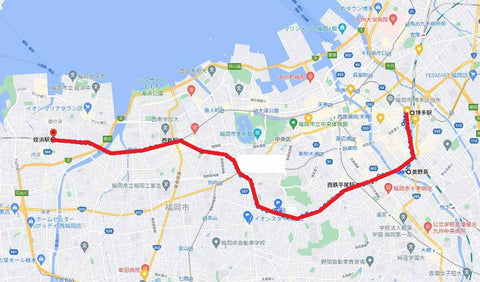
A bicycle is the best way to explore the remnants of the Chikhi Line.
Although it's a long distance, speed isn't necessary, so even a mini velo can be used to explore.
Bridge Design
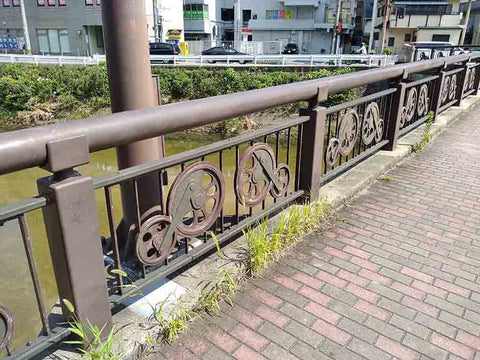
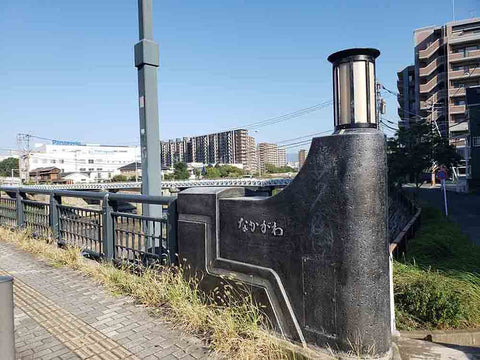
Bridges along the former Chikhi Line are designed to mimic steam locomotives or train wheels.
These would be completely missed by car.
It's a trace that can only be found by cycling.
There are several bridges; the "Nakagawa Chikhi Bridge" has a locomotive design, and the "Muromigawa Chikhi Bridge" and "Hiikawa Chikhi Bridge" have wheel designs.
Railway Land Becomes a Park
"Baikoin Ryokudo" near Ropponmatsu and Ozasa, and "Minoshima Ryokudo" in Minoshima, have been converted into parks using the former Chikhi Line land.
These areas can only be explored on foot or by bicycle.
Please do try cycling through them.
In Baikoin Ryokudo, you can feel the remnants, with monuments like tunnels.
Also, railway ties are used in the landscaping of Baikoin Ryokudo, and boundary stones from the former Japanese National Railways can still be seen.

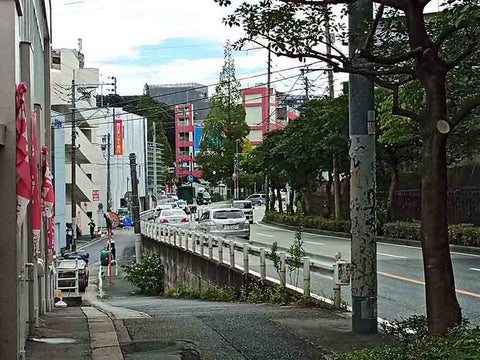
Where the Tracks Used to Be is Now a Road
Some parts of what used to be the railway tracks are now roads.
As a result, a two-lane railway track might have become a three-lane road.
If you thought the roads seemed unusually narrow, there are places where three lanes were squeezed in.
By looking from a distance on a bicycle, you can see how the height was forcibly adjusted.
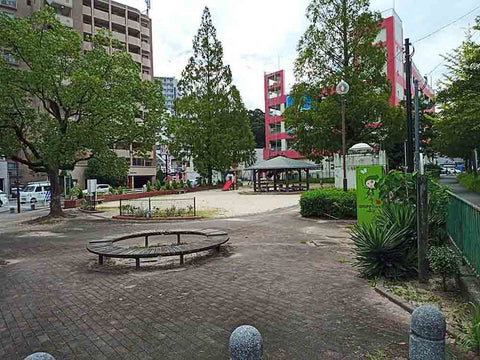
Former Station Becomes a Park
The former Ozasa Station is now a park.
You wouldn't know it unless you were told, but there's a curiously shaped road, and knowing it was once a station makes sense.
To the north of the former Ozasa Station is the Fukuoka City Zoological Garden, which is still in operation.
To the south is the Ozasa Shopping Street, also still active.
Exploring the Ozasa Shopping Street, you'll find a mix of old and new shops, which should be enjoyable.
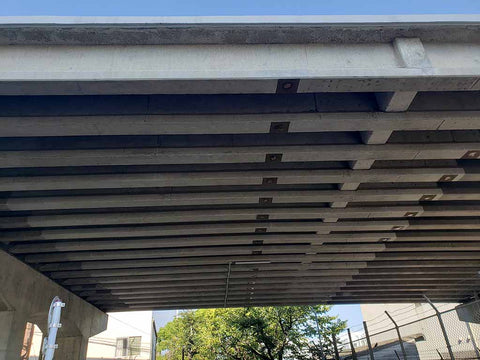
Traces of Locomotive Smoke Below a Ramp
Some bridges have ramps that were built even before the Chikhi Line was abandoned.
Since steam locomotives also ran on the Chikhi Line, they sometimes emitted smoke as they moved.
The soot remained on the underside of these ramps.
However, unfortunately, due to recent renovations, the soot can no longer be seen.
But since it's clearly cleaner now, that itself could be considered a remnant.
This, too, would be difficult to find without a bicycle.
Currently, it's such a rare spot that even some Fukuoka residents don't know about it.
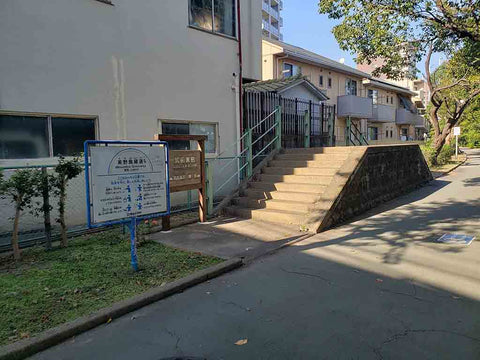
Greenway Modeled After a Station
Near Hakata Station is the Minoshima Greenway.
Here, a monument modeled after a train platform still remains.
Moreover, it's a promenade of about 1.2 km, so you can enjoy walking or cycling through it, searching for the remnants of the Chikhi Line.
The Former Chikhi Line: An Enjoyable Tourist Attraction
When cycling along the former Chikhi Line, around Ropponmatsu near Baikoin Ryokudo, you can enjoy various gourmet foods.
New and stylish shops have emerged due to recent redevelopment.
It's a good idea to park your bicycle and explore.
Ropponmatsu has well-maintained bicycle parking, making it easy to park.
Car parking is chronically insufficient, so it's unlikely you'd be able to leisurely park and explore by car.
In Ropponmatsu, some shops still remain from when the former Chikhi Line was in operation, so it's interesting to look for them.
Nishijin Shopping Street
The long Nishijin Shopping Street has historically been a student town.
There are many inexpensive and delicious restaurants, and you could spend a whole day exploring it thoroughly.
It can be a bit crowded in places, making it an important spot where anyone can experience the atmosphere of Fukuoka's old town.
The coast where Machiko Hasegawa, the author of Sazae-san, conceived the idea for Sazae-san during her wartime evacuation, is also very close by.
There are various monuments, so cycling around will lead to new discoveries.
Reason for the Abandonment of the Chikhi Line
As you cycle along the former Chikhi Line, you'll notice that there were actually 43 intersections with roads.
When Fukuoka City was redeveloped about 40 years ago, some of these 43 intersections were causing traffic congestion.
Building overpasses might have been one solution, but 43 intersections seemed to be too many.
In reality, it's believed that the line was abandoned due to aging infrastructure and traffic congestion measures, despite not having few users.
After about 40 years, cycling along the new subway lines and the former Chikhi Line is exciting even if you're not a railway enthusiast.
Please give it a try.