![AERO 40 Ⅱ ディスクブレーキホイール[リム内幅23mm] - ICANホイールジャパン](http://icanjp.com/cdn/shop/files/1_d90bc651-48bd-4f22-9e13-6d963c283ba6_1370x.jpg?v=1753869976)
![AERO 40 Ⅱ ディスクブレーキホイール[リム内幅23mm] - ICANホイールジャパン](http://icanjp.com/cdn/shop/files/2_37e9600e-9785-4d45-abe1-df49da71e7ee_1370x.jpg?v=1753869976)
![AERO 50 Ⅱ ディスクブレーキホイール[リム内幅23mm] - ICANホイールジャパン](http://icanjp.com/cdn/shop/files/ICANAERO50IIDiscWheels_1_1370x.jpg?v=1758088613)
![AERO 50 Ⅱ ディスクブレーキホイール[リム内幅23mm] - ICANホイールジャパン](http://icanjp.com/cdn/shop/files/ICAN_AERO_50_II_Disc_Wheels_2_1370x.jpg?v=1758088881)


![FL40Ⅱ ワイドリムロードカーボンホイール 軽量「内幅23mm] - ICANホイールジャパン](http://icanjp.com/cdn/shop/files/1_771b4686-2e73-4d35-b47c-b123b298f7f7_1370x.jpg?v=1755486826)
![FL40Ⅱ ワイドリムロードカーボンホイール 軽量「内幅23mm] - ICANホイールジャパン](http://icanjp.com/cdn/shop/files/2_76389d17-9f29-42af-aa59-a695414fcaf7_1370x.jpg?v=1755486826)
Is Your Bicycle's Tire Pressure Optimal?! The Relationship Between Tire Pressure and Rolling Resistance
Have you ever ridden a bicycle and felt like it was strangely heavy?
Several reasons come to mind, and one of them is that "the tire pressure is not appropriate."
Specifically, it's possible that air has escaped.
When riding a road bike, you might be told that it's good to inflate the tires once a week, but if air escapes every single week, then it's a flat tire, right?
Please understand that "inflating the tires" should be interpreted as "checking the tire pressure" or "managing the tire pressure."
Why does low tire pressure increase pedaling resistance?
While "pedaling resistance" isn't a common term, it refers to the force required when pedaling.
Why is more force needed when pedaling when tire pressure drops, i.e., when air escapes from the tires?
It's commonly thought that the contact area with the ground increases, thus increasing resistance.
While that's not incorrect, there also seems to be an issue of "efficiency."
Low tire pressure means there's more leeway between the rim and the ground, in other words, in the tire itself.
Therefore, when you pedal, the rotational force is transmitted to the tire rim via the chain and sprocket, but some of that force is used to deform the tire, and only after the tire has been deformed to its limit is the force transmitted to the ground.
A portion of the force you apply when pedaling is used to deform the tire, meaning it's not 100% utilized to propel you forward.
However, surprisingly, the relationship between tire pressure and pedaling resistance hasn't been extensively researched, even at universities.
I've looked through research papers, but I haven't found the specific answers I'm looking for, like "X% tire pressure leads to Y% pedaling resistance."
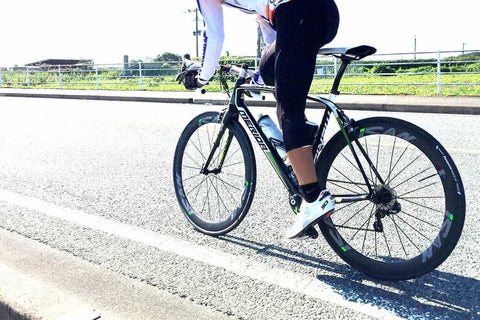
How to transmit 100% of pedaling force to the tires
At least, we've learned that requiring more pedaling force than usual is partly due to low tire pressure, and this is because of the increased contact area with the ground and the force being used to deform the tire itself.
Based on that, it's clear that the only thing to do is to increase tire pressure until the tires are firm.
Road bikes and mountain bikes have completely different tire widths, but both ride smoothly when the tire pressure is appropriate, right?
I think you now understand why.
In other words, having less air in the tire and more leeway creates more resistance than the width of the tire's contact area.
Between narrow and wide tires, narrow tires, like those on a road bike, are more advantageous, but what's more important is maintaining proper tire pressure to prevent them from deflecting.
Each bicycle has an appropriate tire pressure
The appropriate tire pressure varies depending on the tire's width.
Therefore, it's not easy to simply say, "Set it to ○ kg."
Furthermore, different units are used depending on the country, such as "PSI," "BAR," and "kPa."
Unlike the unit of weight "kg," these are units of "pressure," expressed as force per unit area.
In most cases, tire pressure is written in two patterns: "PSI" and "BAR."
Both refer to the same pressure; only the units of expression differ.
By the way, if you want to convert them, it's as follows:
1kgf/cm2 = 14.2233psi = 0.980665bar = 98.0665kPa
In Japan, the unit of weight "kg" is used, so thinking of it as "1 kg applied to a 1 cm x 1 cm area" might give you an idea of how high or low the pressure is.
PSI and bar refer to the same thing, but they are used in units familiar to each respective country.
The air we live in (atmospheric pressure) is 1013.25 mbar (millibars), which can be considered the same as 1013.25 hPa (hectopascals).
Since 1000 mbar = 1 bar, the appropriate pressure for a road bike is around "6 bar to 9 bar," meaning compressed air is put into the tires at about 6 to 9 times atmospheric pressure.
Once understood, this knowledge can be applied in various situations when needed.
Bicycle types and approximate appropriate tire pressure
There are many types of bicycles, and their tire widths and diameters vary, so it's impossible to give a precise answer, but I'll provide a general guide for appropriate pressure.
Road Bike: 90~125 psi / 6.2~8.6 bar
Cross Bike: 65~100 psi / 4.5~6.9 bar / 450~690 kPa
Mountain Bike: 30~50 psi / 2.1~3.4 bar
City Bike (Mamachari): 44 psi / 3 bar / 300 kPa
Looking at this, you can see that road bikes and cross bikes have higher tire pressures.
Mountain bikes and city bikes have lower tire pressures.
This is related to the tire width.
And the appropriate tire pressure for your bicycle is written on your bicycle's tires.
This is the pressure that the manufacturer expects it to be used at, so it's best to follow it.
There's a difference of about 2 atmospheres, so within that range, individual preferences can be accommodated, such as "using higher pressure" or "using lower pressure."
If you want to reduce "pedaling resistance" and pedal more easily, you should set the tire pressure to the higher end of the appropriate range.