![AERO 40 Ⅱ ディスクブレーキホイール[リム内幅23mm] - ICANホイールジャパン](http://icanjp.com/cdn/shop/files/1_d90bc651-48bd-4f22-9e13-6d963c283ba6_1370x.jpg?v=1753869976)
![AERO 40 Ⅱ ディスクブレーキホイール[リム内幅23mm] - ICANホイールジャパン](http://icanjp.com/cdn/shop/files/2_37e9600e-9785-4d45-abe1-df49da71e7ee_1370x.jpg?v=1753869976)
![AERO 50 Ⅱ ディスクブレーキホイール[リム内幅23mm] - ICANホイールジャパン](http://icanjp.com/cdn/shop/files/ICANAERO50IIDiscWheels_1_1370x.jpg?v=1758088613)
![AERO 50 Ⅱ ディスクブレーキホイール[リム内幅23mm] - ICANホイールジャパン](http://icanjp.com/cdn/shop/files/ICAN_AERO_50_II_Disc_Wheels_2_1370x.jpg?v=1758088881)


![FL40Ⅱ ワイドリムロードカーボンホイール 軽量「内幅23mm] - ICANホイールジャパン](http://icanjp.com/cdn/shop/files/1_771b4686-2e73-4d35-b47c-b123b298f7f7_1370x.jpg?v=1755486826)
![FL40Ⅱ ワイドリムロードカーボンホイール 軽量「内幅23mm] - ICANホイールジャパン](http://icanjp.com/cdn/shop/files/2_76389d17-9f29-42af-aa59-a695414fcaf7_1370x.jpg?v=1755486826)
"There's no theory to cycling" proven by mathematicians at the Tokyo Olympics
There were many things that happened, but the 2021 Tokyo Olympics were held.
As an author who writes articles about bicycles, I can't help but be interested in cycling, even at the Olympics.
Normally, I'm not very interested in people; I'm purely interested in bicycles.
I repeatedly watch videos and study what kind of bicycles world-class athletes, like those who compete in the Olympics, ride, and how they adjust their parts.
However, something happened at this Olympics that forced me to pay attention to a person.
An unknown athlete won a gold medal in the "Cycling Road Race - Women's" event.
Moreover, she had only been cycling for seven years and had the unusual background of being a mathematician.
Perhaps it was her calculation, but the strong competitors from around the world didn't even know they were in second place when they crossed the finish line.
There was a moment when the atmosphere froze as they joyfully crossed the finish line thinking they were first, only to be informed later that they were second.
Not only that, but this first-time Olympian mathematician, Anna Kiesenhofer, won a gold medal after doing many things that went against the theory of road cycling, so let's look back at how unconventional she was.

No Pacing
The Olympic race was 137 km long.
137 km is roughly the distance from Tokyo to Mount Fuji.
Normally, one would pace themselves.
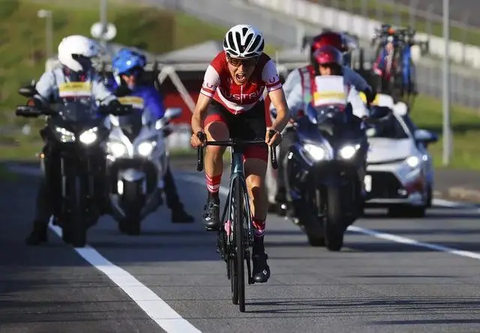
However, Kiesenhofer went full throttle from the 2 km mark.
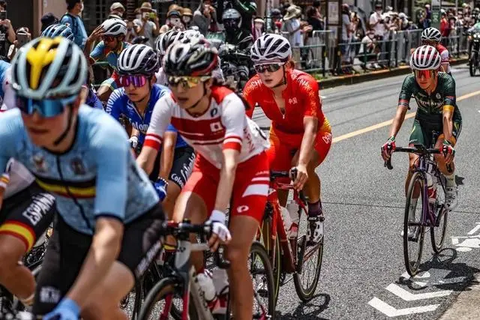
Of course, there were other riders, but their pace gradually dropped, and a "peloton," which is the theory of road cycling, formed.
The "peloton" sets the pace, and to be left out of it means "defeat."
Those who started fast also gradually lost pace and were swallowed by the "peloton," becoming part of the group.
At this time, Kiesenhofer never fell back to the main group.
She constantly rode at the front, and everyone assumed the "peloton" was in the lead.
Who would think that someone would ride at full speed for 137 km?
Because of the long distance, there are "phases" for sprinting, cruising, and the final sprint.
Kiesenhofer was not swallowed by the peloton, so she continuously rode at the front at full speed.
And her presence was not noticed by the "peloton" until she crossed the finish line.
Not affiliated with a team
The second unconventional thing is that Kiesenhofer is not affiliated with a team.
Normally, in cycling, teams are formed, and each member has a role.
Even in individual competitions, it's common for groups to form by country or team, and for riders to take turns at the front, which has high wind resistance, while conserving energy.
Amidst this, countries and teams jockey for position, moving forward and backward.
However, Kiesenhofer is not affiliated with any team to begin with, nor was she swallowed up by any group.
She constantly rode at full speed without having to match anyone's pace.
In the manga "Yowamushi Pedal," many charismatic characters appear, but there isn't a single "athlete who doesn't cooperate with anyone" like her.
Kiesenhofer's unconventional riding style was something that couldn't be predicted not only in reality but also in manga.
No Coach
It is normal for athletes competing in the Olympics to have a "coach" who provides physical and mental guidance and support.
They would have no way of knowing how much and what kind of training would make them faster.
By having a coach, often someone with experience as an athlete, they can learn whether their current riding is good or bad, and if they are improving at a good pace.
Furthermore, humans are not always in peak condition.
A coach praises them when they are not doing well, or conversely, tightens the reins when they are getting overconfident, managing their mental state which they cannot manage by themselves.
Also, diet is an important factor for athletes.
They must consume the necessary nutrients and build a strong body that can endure the race.
Naturally, knowledge of nutrition and other related fields is required here.
Kiesenhofer manages everything herself.
In a post-race interview, she replied, "I am an amateur. I have to manage everything myself, including nutrition, equipment, and race plans, but that is also my pride."
No mechanic
Kiesenhofer also does not have a mechanic.
From choosing the type of bicycle, she selects all parts herself.
She judges whether things are in good or bad condition and adjusts them herself.
Adjusting a bicycle is a bit of a rabbit hole; once you start thinking, "Is there a better adjustment?", there's no end to it.
No sponsors
This may not be apparent, but it is extremely significant.
Not having bicycle manufacturers or parts manufacturers as sponsors means that all costs, including the purchase of bicycles and parts, fall on her.
Furthermore, if there's no one to financially support her to focus on training, she has to generate income while training and then improve her skills.
While professionals can dedicate all their time to training, Kiesenhofer trained while also conducting research.
Summary
The athlete who won first place on the world's biggest stage, the Olympics, broke all the theories and did her best according to her own plan.
What I wanted to convey here is that while imitating what famous athletes do is understandable from a fan's perspective, it doesn't necessarily make you stronger.
This event showed that believing in yourself, rather than rushing blindly, can also lead to strength.