

![AERO 40 Ⅱ ディスクブレーキホイール[リム内幅23mm] - ICANホイールジャパン](http://icanjp.com/cdn/shop/files/1_d90bc651-48bd-4f22-9e13-6d963c283ba6_1370x.jpg?v=1753869976)
![AERO 40 Ⅱ ディスクブレーキホイール[リム内幅23mm] - ICANホイールジャパン](http://icanjp.com/cdn/shop/files/2_37e9600e-9785-4d45-abe1-df49da71e7ee_1370x.jpg?v=1753869976)
![AERO 50 Ⅱ ディスクブレーキホイール[リム内幅23mm] - ICANホイールジャパン](http://icanjp.com/cdn/shop/files/ICANAERO50IIDiscWheels_1_1370x.jpg?v=1758088613)
![AERO 50 Ⅱ ディスクブレーキホイール[リム内幅23mm] - ICANホイールジャパン](http://icanjp.com/cdn/shop/files/ICAN_AERO_50_II_Disc_Wheels_2_1370x.jpg?v=1758088881)


![FL40Ⅱ ワイドリムロードカーボンホイール 軽量「内幅23mm] - ICANホイールジャパン](http://icanjp.com/cdn/shop/files/1_771b4686-2e73-4d35-b47c-b123b298f7f7_1370x.jpg?v=1755486826)
![FL40Ⅱ ワイドリムロードカーボンホイール 軽量「内幅23mm] - ICANホイールジャパン](http://icanjp.com/cdn/shop/files/2_76389d17-9f29-42af-aa59-a695414fcaf7_1370x.jpg?v=1755486826)
Gloves for preventing bicycle accidents in winter
When riding a bicycle in winter, my hands get numb with cold.
According to the Metropolitan Police Department, traffic accidents tend to increase in winter.

From the Metropolitan Police Department website
I think the shorter daylight hours also play a role, but what I personally often see is "one-handed riding."
People ride with one hand in their jacket pocket because it's cold.
I rarely see people on road bikes or cross bikes doing this, but it seems quite common for those on city bikes (mamachari).
Bicycles and gloves are inextricably linked.
We should strive to prevent accidents by using proper gloves.
Why do your hands get cold when cycling?
Consider the relationship between perceived temperature and wind.
Generally, it is said that the perceived temperature drops by 1°C for every 1m/s increase in wind speed.
In other words, let's consider riding at 20 km/h when the ambient temperature is 10°C.

A wind speed of 1m/s converts to 3.6 km/h.

So, riding at 20 km/h means the perceived temperature drops by 20 ÷ 3.6 = 5.55 ≈ 5.6 degrees.


In winter, the outside temperature can be 5 degrees or even 3 degrees.

In such conditions, it's natural to feel cold when the perceived temperature drops by as much as 5.6 degrees.
What kind of gloves are good? Required conditions
When choosing gloves for cycling, ordinary gloves are not enough.
In the case of knitted gloves, wind can enter through the gaps in the yarn, making your hands cold even with gloves on.
It's better to have gloves made of windproof material.
Generally, windproof materials are synthetic fibers like polyester.
If you prefer thick gloves, ski gloves are recommended.

As expected from gloves designed for skiing, they are windproof, durable, and relatively thin.
If you're looking for something affordable, rubber-coated gloves from a 100-yen shop are recommended.
Anti-slip treatment is desired
When considering cycling gloves instead of everyday gloves, they need to allow you to grip the handlebars and also operate the brake levers.
Therefore, gloves that are too thick and restrict finger movement are not suitable.
Ski gloves are designed to grip ski poles, so they have anti-slip features on the palm.
Despite their bulky appearance, they allow for easy finger movement, making it easy to grip the brake levers.
The rubber-coated gloves from 100-yen shops are originally meant for moving or farm work, so they are designed to prevent slipping when grasping objects.
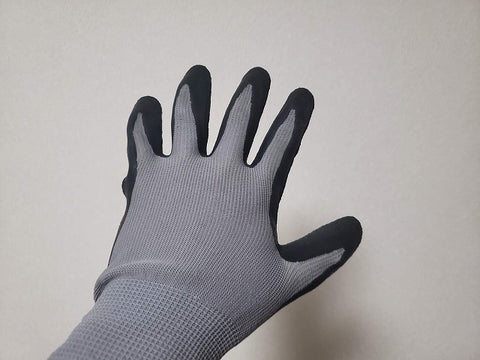
If they are fully rubber, they can get stuffy, which is also inconvenient.
Rubber-coated gloves have thin backs, allowing for moderate breathability, making them quite useful in not-so-cold temperatures around 10 degrees Celsius.
If you sweat
When riding a road bike or cross bike, you gradually start to sweat.
Naturally, your body temperature rises.
Your hands may not need as much warmth as provided by the ski gloves mentioned above.
Therefore, I carry both ski gloves and rubber-coated gloves. I use ski gloves during the cold winter mornings, and after about 10 minutes of riding when my body warms up, I switch to the rubber-coated gloves.
If you use your bike for commuting to work or school, such ingenuity is necessary.
Since the unused gloves will be stored in a bag, overly bulky ones would be cumbersome.
For road bikes, be particular about the rubber too.
For road bikes and cross bikes, even if you choose rubber-coated gloves, you might want to be a bit particular about the material.
There are many different types of rubber.
Also, the surface processing method greatly changes the feel, such as slipperiness and cushioning.
Some people want to feel the subtle vibrations from the ground, while others dislike them.
Gloves can make a big difference, so it's recommended to check them beforehand if possible before purchasing.
Design is also important
Especially for those who ride sports bikes, I think design is also important.
Gloves from well-known manufacturers are certainly superior in functionality and provide excellent cold protection.
However, their price also tends to be higher, around 5,000 yen.
Ski gloves, on the other hand, typically cost around 1,000 to 2,000 yen, which is considerably cheaper.
Some gloves are designed for both summer and winter use, with detachable fingertips, so it can be enjoyable to search based on your preferences.
However, it's important not to forget that the top priority is "cold protection."
If the cold protection is weak despite a cool design, I think you should choose something else.
Check compatibility with your bike's grips
Once you have your gloves ready, you shouldn't use them immediately; it's advisable to do a short test ride beforehand.
This is because depending on the material of the grip, synthetic fibers and rubber can either slip too much or, conversely, not slip at all, making riding difficult.

After confirming that you can grip the handlebars and checking for slipperiness, grip the brake levers and ensure that you can brake properly.
It is safer to test ride in your neighborhood and confirm everything is okay before starting to use them regularly.
External writer: Koichi Okuno
2 Comments
ご指摘ありがとうございます。
弊社契約のライターに確認したところ、
ご指摘の通り、計算方法を間違ていたとのことでした。
訂正し、お詫び申し上げます。
この度は、ご指摘いただきありがとうございました。
今後ともICANをよろしくお願いいたします。
体感温度の計算が間違ってますよ。風速毎秒1mは時速3.6kmです。文中のは分速と間違えていますね。そして時速3.6kmにつき1度下がるのですから、時速20kmでは20÷3.6=5.55と5.5度くらい下がることになるはずです。