![AERO 40 Ⅱ ディスクブレーキホイール[リム内幅23mm] - ICANホイールジャパン](http://icanjp.com/cdn/shop/files/1_d90bc651-48bd-4f22-9e13-6d963c283ba6_1370x.jpg?v=1753869976)
![AERO 40 Ⅱ ディスクブレーキホイール[リム内幅23mm] - ICANホイールジャパン](http://icanjp.com/cdn/shop/files/2_37e9600e-9785-4d45-abe1-df49da71e7ee_1370x.jpg?v=1753869976)
![AERO 50 Ⅱ ディスクブレーキホイール[リム内幅23mm] - ICANホイールジャパン](http://icanjp.com/cdn/shop/files/ICANAERO50IIDiscWheels_1_1370x.jpg?v=1758088613)
![AERO 50 Ⅱ ディスクブレーキホイール[リム内幅23mm] - ICANホイールジャパン](http://icanjp.com/cdn/shop/files/ICAN_AERO_50_II_Disc_Wheels_2_1370x.jpg?v=1758088881)


![FL40Ⅱ ワイドリムロードカーボンホイール 軽量「内幅23mm] - ICANホイールジャパン](http://icanjp.com/cdn/shop/files/1_771b4686-2e73-4d35-b47c-b123b298f7f7_1370x.jpg?v=1755486826)
![FL40Ⅱ ワイドリムロードカーボンホイール 軽量「内幅23mm] - ICANホイールジャパン](http://icanjp.com/cdn/shop/files/2_76389d17-9f29-42af-aa59-a695414fcaf7_1370x.jpg?v=1755486826)
Areas of the body that get tired depending on the shape of bicycle handlebars
What kind of bicycle do you prefer?
There are many types of bicycles with various shapes and handlebar styles.
If they were all the same, any would do, but each shape has a purpose.
Here, I'll explain the differences in handlebar shapes and the body parts that tend to get fatigued as a result.
Simply informing you wouldn't be very helpful, so I'll also provide countermeasures.
If you were to count them, there are quite a few types of bicycle handlebars.
However, there are only four common types, and we will cover all of them.
■ Semi-riser handlebars
They have many aliases, such as "praying mantis handlebars" or "wide-rise handlebars," but essentially, these are the handlebars found on a "mamachari" (city bike).

They have an arc-like shape, with only the grip area slightly raised.
When you lower the saddle and raise the handlebars, your body becomes upright, and your arms are less likely to get tired.
However, since all your weight is supported by your backside, riding long distances will make your bottom sore.
Also, if the handlebars are too high, your wrists will get tired.
If you raise the saddle and lower the handlebars, your body will lean slightly forward.
However, riding long distances will still make your bottom sore.
Your wrists will also get tired without you realizing it.
This is because you constantly twist your wrists to grip the handlebars.
This is also why long-distance riding on a city bike is not highly recommended.
They are perfect for shopping trips of about 1-2 km from home to the supermarket.
■ Flat handlebars
Also known as riser handlebars.
These are handlebars that are almost straight across, similar to those on an MTB.

With the saddle set high and leaning forward, some of your body weight is supported by the handlebars, so your bottom is less likely to get sore even during long rides.
In the case of MTBs, the suspensions at various points absorb road shocks and vibrations to some extent, making your bottom even less likely to hurt.
However, if weight is on the handlebars, it also means weight is on your hands, so the base of your palm near your wrist will start to hurt during long rides.
Therefore, it's a good idea to wear gloves as a preventative measure when riding long distances.
■ Drop handlebars
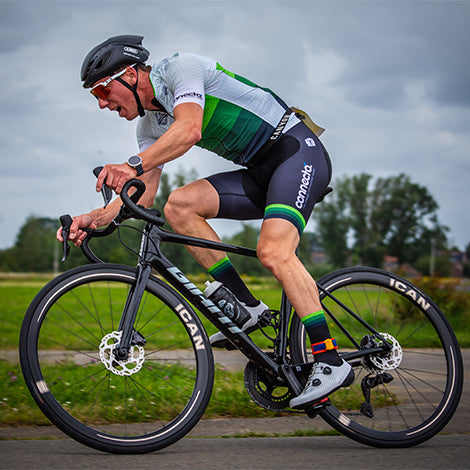
Drop handlebars are commonly used on many sports bikes. The center is almost flat, but about shoulder-width apart, they bend 90 degrees forward, then curve downwards in an arc shape.

You can change your riding posture by gripping different positions, allowing you to alter your posture and wind resistance whether you want to cruise or ride at full speed.
When gripping the flat central part, your body is upright, and there is almost no strain on your arms.
Normally, you grip around the point where it first bends 90 degrees, hooking your thumb and index finger around the base of the brake levers.
In this posture, your upper body is relatively upright, so there is less strain on your hands and relatively less strain on your backside.
However, during long rides, the base of your thumb and index finger on your palm may become sore.
This can also be alleviated to some extent with gloves.
When riding at full speed, you grip the curved, downward-sloping part.
This is a complete forward-leaning posture with the least wind resistance.
Since you are leaning forward, there is a significant strain on your arms, but your backside is barely putting weight on the saddle, so the strain shifts to your legs.
■ Bullhorn handlebars
It can be said that this shape originated from the drop handlebars mentioned above.
They have a shape that looks like the curved part of drop handlebars has been cut off.
This handlebar type is often used in time trials and triathlons.
Similar to drop handlebars, you can change your grip position when you want to go fast or cruise leisurely, thereby changing your posture.

■ Summary
There are various shapes of bicycle handlebars, but they can be broadly classified into four types.
By choosing handlebars according to your purpose and customizing them, you can enjoy a more comfortable cycling life.
Since the location of strain varies depending on the handlebar shape, bicycle adjustments, gripping position, and distance ridden, it's important to understand these factors and take preventative measures in advance.